
Key takeaways:
- Building English vocabulary that sticks: Studies in China and Iran found that students using Kahoot! achieved higher scores on vocabulary tests, including assessments conducted after the initial learning period.
- Greater confidence and motivation: Research from Chile, Turkey, and Thailand highlights improvements in English learners’’ confidence, motivation, and engagement.
- Supporting English learners of different ages: Research spanning primary school through university shows how game-based practice can be integrated into English language learning at different educational levels.
- Beyond English language learning: Studies also explore the use of Kahoot! in Arabic, French, Japanese, and Russian language learning contexts.
Learning English as a foreign or second language takes more than memorizing words and grammar rules. Students need opportunities to practice, learn from mistakes, and build the confidence to communicate in English.
So how can teachers make that practice both effective and engaging?
Research from English language classrooms around the world offers some promising insights. This article brings together findings from 13 studies across 10 countries, exploring how Kahoot! is being used to support English vocabulary development, reading comprehension, grammar practice, motivation, and learner confidence.
The findings highlight measurable improvements in English vocabulary learning and retention in several studies, alongside encouraging results for student confidence, motivation, and classroom participation.
English language learning across borders and classrooms
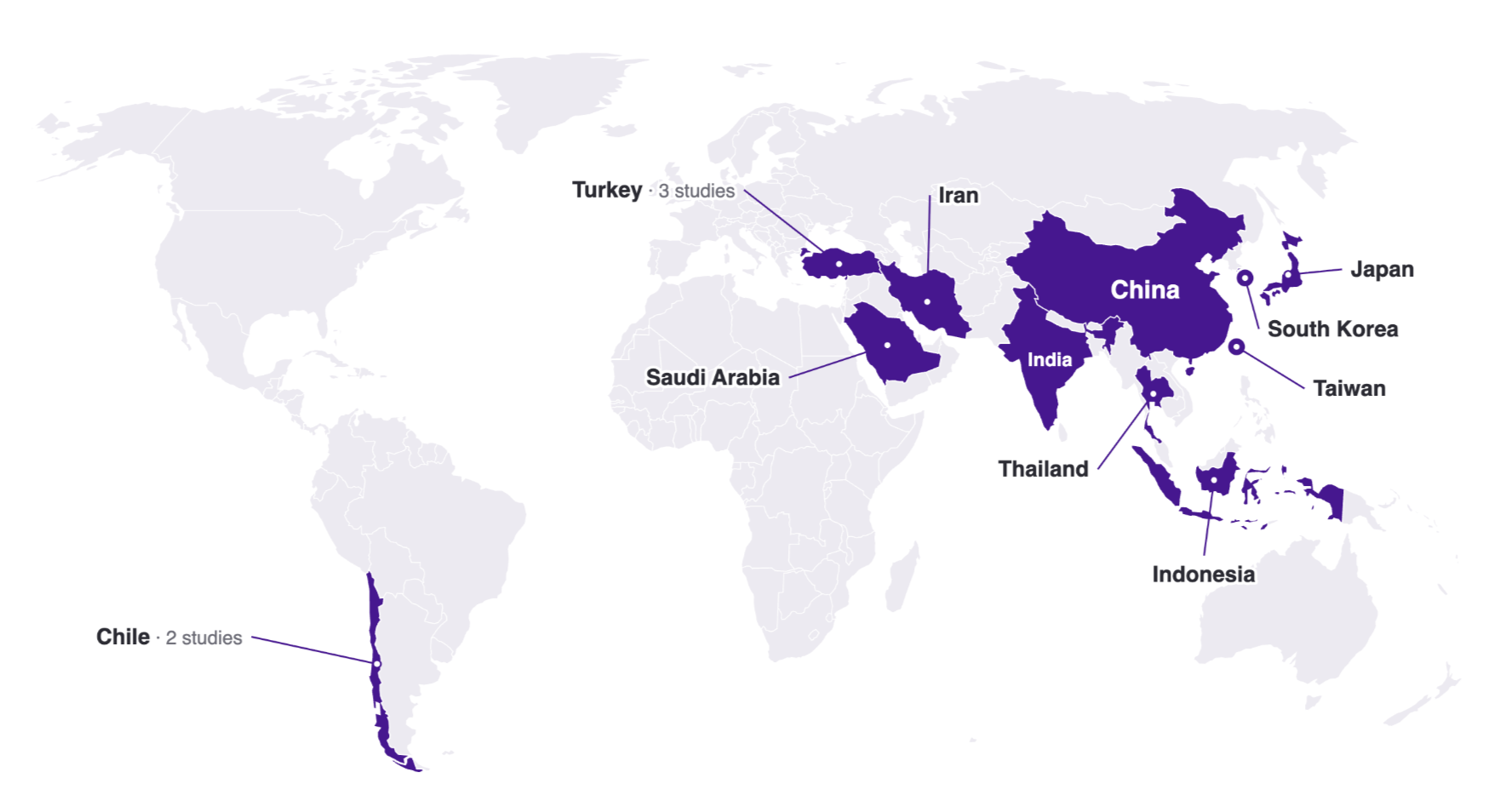
From English vocabulary lessons in Chile to university English reading classes in Turkey, researchers have explored how Kahoot! fits into different English as a foreign or second language learning environments.
The featured studies span primary school, secondary education, and university, covering a range of English language skills and learning objectives.
Some researchers examined measurable improvements in English vocabulary, grammar, or reading comprehension. Others focused on how students experienced learning English, including their confidence, motivation, and willingness to participate.
Together, the studies offer an international perspective on how game-based learning can complement English language teaching, while also highlighting the importance of looking beyond test scores alone.
Building English vocabulary that sticks
Developing a strong vocabulary is one of the foundations of learning English. But recognizing a new English word immediately after a lesson is only part of the challenge. Students also need to remember and use what they have learned over time.
Research from China and Iran offers encouraging evidence that Kahoot! can support English vocabulary learning and retention.
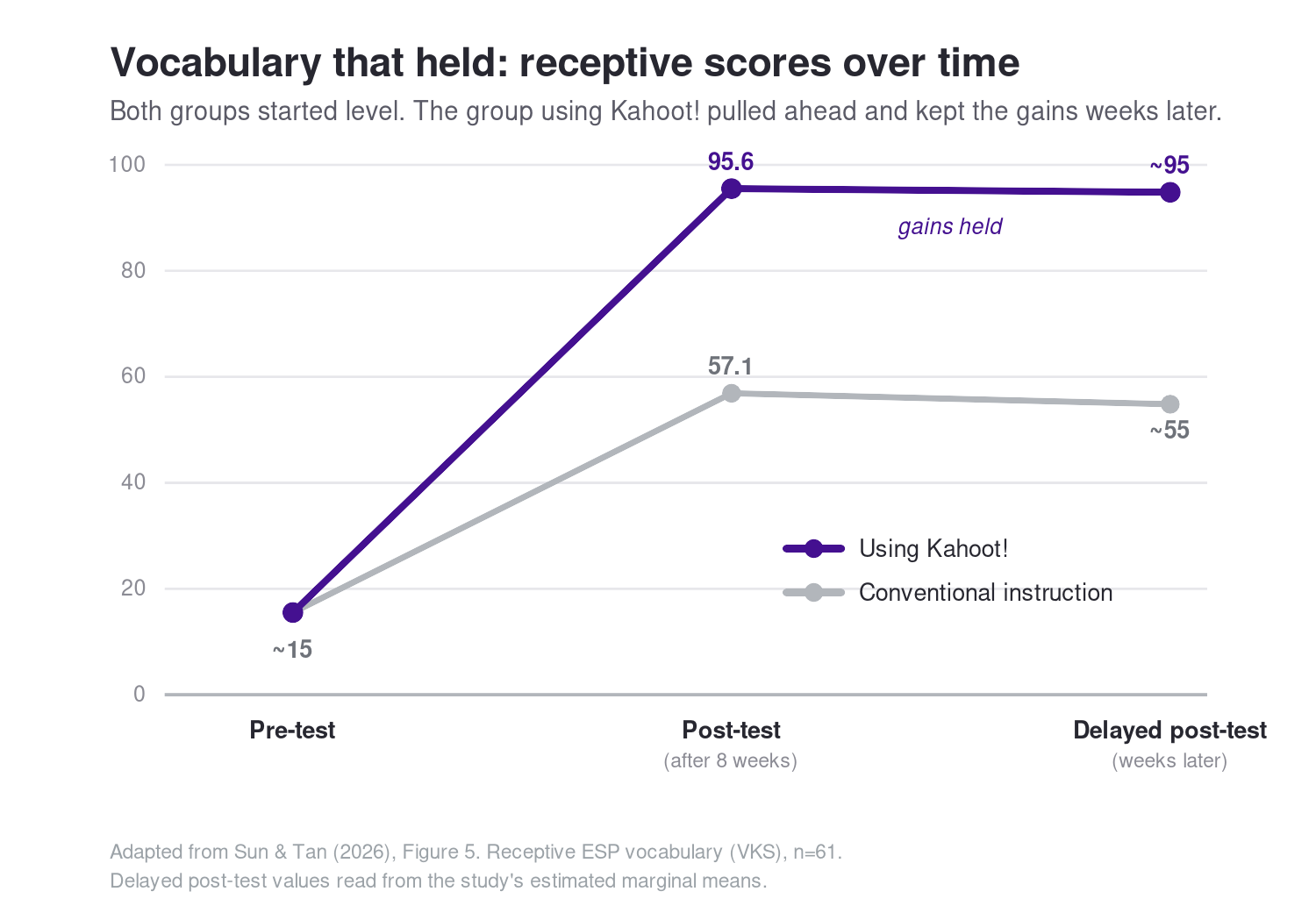
At a university in China, Sun and Tan (2026) investigated the use of Kahoot! in an English for Specific Purposes (ESP) vocabulary course involving 61 students. Students using Kahoot! achieved higher scores than a comparison group receiving instruction without the platform, both in recognizing vocabulary and using words correctly.
On the immediate receptive vocabulary test, the group using Kahoot! averaged 95.59 compared with 57.11 for the comparison group. The advantage also appeared in productive vocabulary knowledge, with scores of 66.26 versus 41.97. On a delayed assessment, the group using Kahoot! stayed close to its immediate post-test level.
Similar findings emerged in Iran, where Ahmed and colleagues (2022) randomly assigned 50 intermediate English students to two groups. Students who practiced vocabulary using Kahoot! significantly outperformed those receiving traditional instruction on both immediate and delayed vocabulary tests.
The positive findings extend to younger learners.
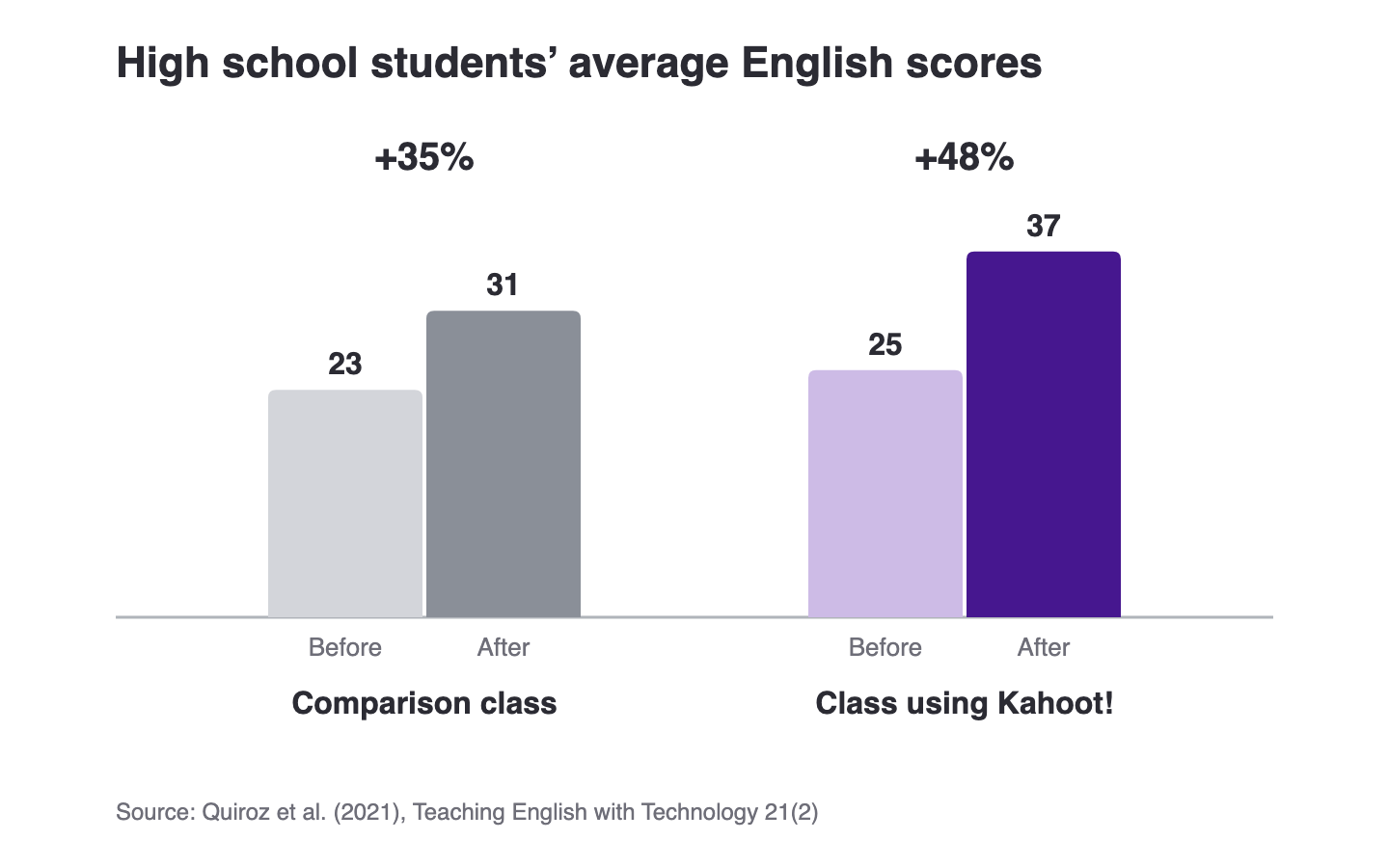
In Chile, Quiroz and colleagues (2021) found that ninth-grade students who practiced English vocabulary with Kahoot! made significantly greater progress than students in a comparison class, with a medium effect size. Both classes improved and the class using Kahoot! gained more: average scores rose 48% compared with 35% in the comparison class not using Kahoot!.
Together, these findings suggest that Kahoot! can be particularly useful for structured vocabulary practice, where repeated retrieval and feedback help students strengthen their knowledge over time.
More confidence, not just higher scores
Learning English is not only about knowing the right words or grammar rules. Students also need the confidence to participate, make mistakes, and try again, especially when practicing a language they are still learning.
And as research suggests, progress isn’t always reflected in test scores alone.
A 2024 study by Cancino and Viguera involving 122 primary school students in Chile offers an example. Researchers compared pupils learning ten English vocabulary items through Kahoot! with pupils using a traditional coursebook.
Both groups performed equally well on the vocabulary post-test. However, students using Kahoot! reported significantly higher vocabulary self-efficacy, which means their confidence in their ability to learn and use new words.
In Turkey, Temel and Cesur (2024) studied 60 university freshmen learning English through gamified tools, including Kahoot!. Compared with students taught through traditional slide presentations, the group using gamified tools showed a statistically significant increase in course motivation (p < .001).
One student described how playing together improved willingness to participate: “We could see that our friends whom we had never heard of were participating in the activities and I think it’s nice. If one can do it, I feel like I can too.”
A study in Thailand found similarly encouraging results. Rofiah and Waluyo (2024) examined an eight-week English course using gamified tools, including Kahoot!, for grammar and vocabulary practice. Students reported significantly higher motivation and classroom engagement, alongside reduced learning anxiety. The benefits were more pronounced in vocabulary activities than grammar activities.
Because the Turkish and Thai studies involved multiple learning tools, their findings cannot be attributed to Kahoot! alone. They nevertheless illustrate how gamified approaches can help create more engaging and supportive opportunities for practicing English.
For English language teachers, the findings reinforce an important point: Helping students feel confident and willing to participate can be a valuable outcome in its own right.
Beyond vocabulary: Grammar, reading, and more
Learning English involves more than remembering new vocabulary. Students also need opportunities to understand grammatical structures, develop reading comprehension, and apply their knowledge in different contexts.
Research shows how Kahoot! is being used to support these different aspects of English language learning.
In India, Navinkumar and Sivakami (2024) studied 68 sixth-grade students learning English as a second language. After practicing grammar with Kahoot!, students demonstrated statistically significant improvements in grammar scores and reported higher motivation and engagement.
At the university level, Korkmaz and Öz (2021) examined the use of Kahoot! questions in English reading classes in Turkey. Over seven weeks, 38 undergraduate students improved their reading scores significantly.
One student pointed out in the study that “Kahoot games encourage and motivate me to read the texts because I want to answer all the questions on the screen.”
Across these different settings, the research illustrates how Kahoot! can be adapted to support a range of English language skills, from recalling vocabulary to practicing grammar and strengthening reading comprehension.
Designing digital activities for English language learners
Research also shows that the way digital activities are designed can be just as important as whether they include game elements.
In Taiwan, Huang (2025) compared collaborative English reading activities using Kahoot! to activities using a non-gamified response tool and no digital tool. Both technology-supported groups achieved higher reading comprehension and midterm exam scores than the group without digital support. The finding suggests that structured, technology-supported participation can benefit language learning, and that not all gains come from gamification alone.
Taken together, the studies point to several ways Kahoot! can contribute to English as a foreign or second language education, while also underscoring the importance of thoughtful implementation.
The strongest evidence in the featured studies relates to English vocabulary learning and retention, with additional findings highlighting confidence, motivation, engagement, grammar, and reading comprehension.
The research at a glance
The 13 featured studies represent a range of English as a foreign or second language learning environments, educational levels, and research approaches, from controlled comparisons and classroom interventions to student surveys and teaching case studies.
- Chile: English vocabulary, primary and secondary school (Quiroz et al., 2021; Cancino & Viguera, 2024). Greater vocabulary gains among ninth-graders; higher vocabulary self-efficacy among primary school pupils.
- China: University ESP vocabulary (Sun & Tan, 2026). Higher immediate and delayed vocabulary performance.
- India: Sixth-grade English grammar (Navinkumar & Sivakami, 2024). Improved grammar scores after Kahoot! practice.
- Indonesia: University English vocabulary (Rojabi et al., 2022). Improved exam performance, engagement, and motivation.
- Iran: Intermediate English vocabulary (Ahmed et al., 2022). Significantly higher immediate and delayed vocabulary scores.
- Japan: Primary-level English and Japanese exchange (Okumura, 2025). Increased interest and engagement in an intercultural learning activity.
- Saudi Arabia: English language classes (Alharthi, 2020). Positive findings for motivation, engagement, and learning outcomes.
- South Korea: University English vocabulary (Reynolds & Taylor, 2020). Vocabulary gains, but no statistically significant between-group difference.
- Taiwan: University English reading (Huang, 2025). Higher reading comprehension and midterm scores with Kahoot! and with a non-gamified tool, compared with no digital tool.
- Thailand: English grammar and vocabulary (Rofiah & Waluyo, 2024). Higher motivation and engagement, with lower anxiety in a multi-tool course.
- Turkey: English reading and classroom motivation (Korkmaz & Öz, 2021; Temel & Cesur, 2024; Küçükali, 2025). Improved reading scores; higher motivation with gamified tools; students rated Kahoot! highest for intrinsic motivation in a survey comparing three platforms.
Research includes studies of different sizes and methodologies. Some evaluate Kahoot! directly, others investigate multiple learning tools, and some report student experiences rather than controlled learning outcomes.
Game-based practice supports vocabulary retention and confidence in English language classes
Across countries and educational levels, one message stands out: giving students opportunities to practice, participate, and receive feedback is an important part of learning English as a foreign or second language.
The research suggests that Kahoot! can help English language teachers create those opportunities in ways that support both learning and the classroom experience.
In vocabulary practice, studies from China, Iran, and Chile provide evidence of measurable learning gains, including stronger retention over time.
Findings from Chile and studies of gamified learning in Turkey and Thailand also highlight the value of helping students feel more engaged and comfortable participating, building confidence and learning motivation.
And from English grammar lessons in India to reading activities in Turkey and Taiwan, researchers continue to explore how interactive practice can support different English language learning objectives.
While no single tool or teaching approach guarantees better results in every classroom, these studies offer useful evidence for educators looking to make English language practice more active, engaging, and effective.
Whether students are learning their first English words or developing more advanced skills, Kahoot! can provide another way to practice, build confidence, and keep learning.