

Most workplace learning follows a familiar pattern.
Employees complete a course, sit through a training session, or join an all-hands meeting. The focus is often on completion rather than what people actually take away from it.
But completing training isn’t the same as learning.
The goal of any training is change: a new behaviour, a different habit, a better way of thinking about a problem. But when learning is reduced to completion, it becomes an activity rather than an outcome. Something to be done, recorded, and moved on from. For the employee, it’s time spent. For the organisation, it’s a number on a dashboard. Neither measures whether anything actually changed.
The real reason training doesn’t stick
Learning that lasts rarely comes from a single exposure — one course, one session, one event — and then nothing. Or another course, another topic, and back to work. Training is done, but nothing really changed.
The reason is rarely the content. It’s the structure around it.
People need a foundation to build on, a reason to care, and an opportunity to revisit what they’ve learned.
In learning science, these are often described as encoding, meaning-making, and spaced review.
Encoding: People learn more effectively when new information connects to something they already know.
Meaning-making: Information becomes memorable when people understand why it matters and how it relates to their own work.
Spaced review: Revisiting and actively recalling knowledge over time helps move learning from short-term memory into long-term retention. Research shows that without reinforcement, people forget the majority of what they’ve learned within 24 hours. Regardless of how good the session was.
Yet most workplace learning is designed around completion. People finish the course. They join the meeting. They pass the quiz.
What’s often missing is a design for what happens before the event and after it.
Blended learning needs a sequence, not just a mix
Blended learning has been part of the L&D vocabulary for years. In many organisations, though, it simply means combining self-paced content with a live session.
What makes blended learning work isn’t the mix of formats. It’s how they’re connected.
A short pre-learning activity serves a different purpose than a live discussion. A follow-up knowledge check serves a different purpose again. When each stage is designed to do its own job—and when they build on one another—the learning experience becomes far more effective than any single event on its own.
The Kahoot! Professional Learning Loop
The Kahoot! Professional Learning Loop is a blended learning method built around that sequence. Three phases designed to work together rather than as disconnected activities.
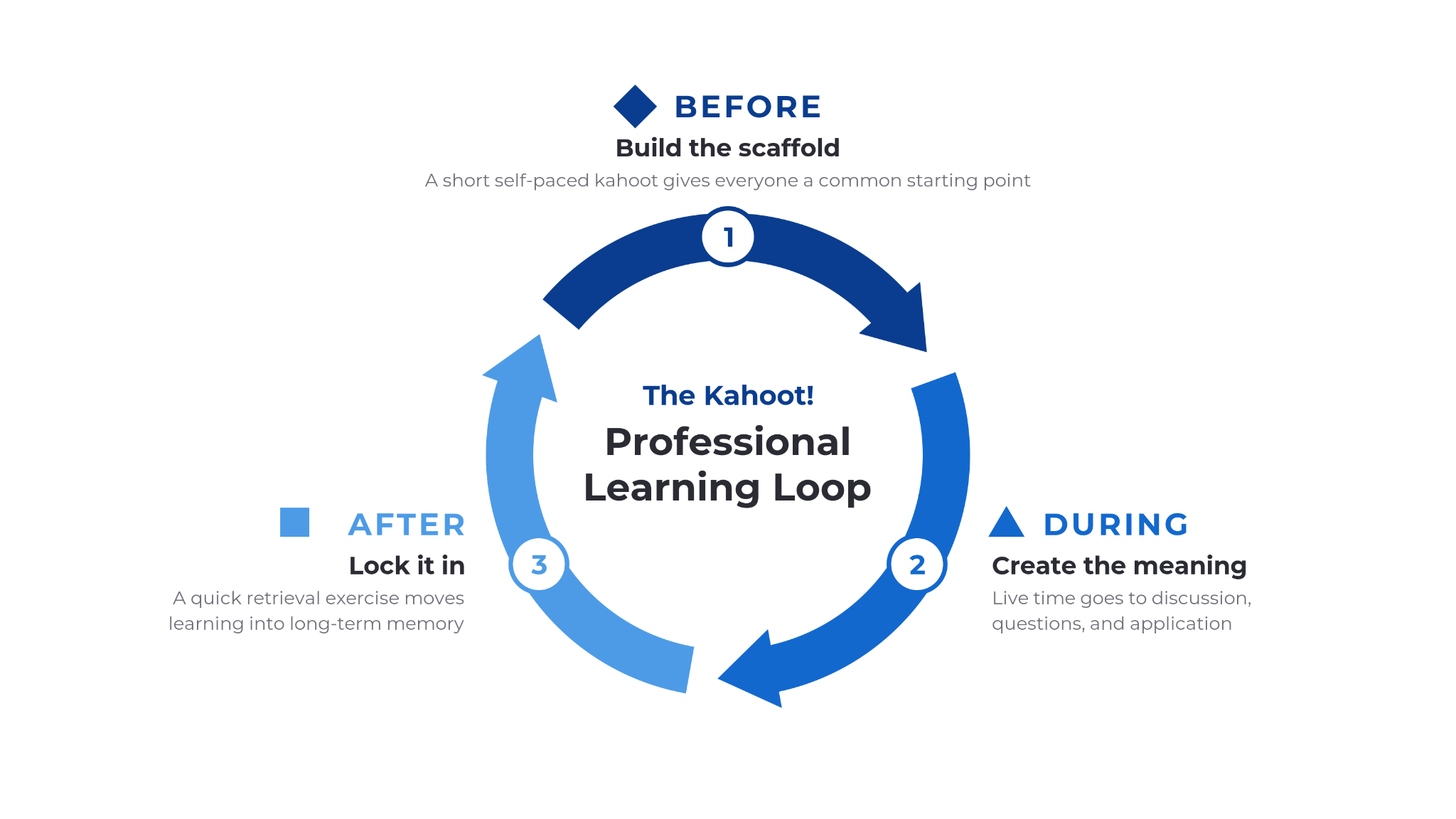
Before: Build the scaffold
Before a live session—a training, town hall, or product kickoff—employees complete a short self-paced Kahoot! challenge.
It introduces the key concepts, surfaces existing knowledge, and gives everyone a common starting point before they come together.
That matters because people learn faster when new information connects to something they already understand. Without this step, the live session becomes learners’ first exposure to the concepts. People are trying to absorb the basics while also listening, responding, and keeping up with the discussion.
A short preparation activity reduces that load. It helps employees arrive ready to participate, not just receive information.
During: Create the meaning
The live session is often the most valuable part of any learning program. It brings people together at the same time, focused on the same topic.
Yet many organisations use that time to deliver information that could have been consumed beforehand.
The better use of live time is discussion, questions, context, and application—the things that are difficult to replicate asynchronously.
This is where people connect information to their own work. A manager explains why a new process matters. A colleague shares a real customer example. Someone asks the question everyone else was thinking. Information gains context, relevance, and emotional connection.
Because learners have already covered the fundamentals, the live session can focus on conversation rather than content delivery. Live polls, Q&As, and interactive challenges help facilitators understand what people know, where they’re uncertain, and where the discussion needs to go next.
A veteran employee and a new joiner will bring different perspectives into the room. The value of the live session is creating a shared understanding despite those differences. That’s something self-paced content alone cannot achieve.
After: Lock it in
What happens after a learning event can matter as much as the event itself.
A short follow-up Kahoot! challenge in the hours or days following a live session—a knowledge check, opinion pulse, or retrieval exercise—helps participants reinforce what they learned while it is still fresh.
This isn’t about testing. It’s about retrieval. When people actively recall information rather than simply re-read it, they are more likely to retain it over time.
Without this step, even a well-designed learning experience can quickly lose momentum. The preparation, discussion, and insights from the live session begin to fade. A simple follow-up activity helps turn a one-time event into learning that lasts.
What this looks like in practice
Take product training for a sales team. The standard approach: a product manager presents new features in a team meeting, answers a few questions, and sends a follow-up email with a recording.
With the Professional Learning Loop: sales reps complete a self-paced challenge on the new features before the meeting. The meeting itself is spent on objection handling, real customer scenarios, and a live Q&A, not feature walkthroughs. Afterwards, a short readiness pulse asks who feels confident to have the conversation. The answer tells managers exactly where to focus coaching time.
The content is the same. The outcome is entirely different.
The same logic applies to compliance training, onboarding, town halls, and leadership development. Any moment where an organisation wants people to not just complete training but actually learn.
Closing the loop
The reason this is a loop rather than a sequence is that each cycle informs the next. Across the three phases, organisations can see not just who attended, but who prepared beforehand, who engaged during the session, and who retained the material afterwards.
That provides a more complete picture of learning and makes it easier to identify gaps, target support, and improve future learning experiences.
From completion to learning
The Kahoot! Professional Learning Loop isn’t a product feature. It’s a framework for designing effective learning.
Prepare people before the event. Use live time for discussion and application. Reinforce learning after the event.
Kahoot! 360 brings all three stages together in one platform. If your organisation is ready to move beyond completion, explore Kahoot 360.