

Key takeaways
- At a Florida teaching hospital, in the intensive care unit (ICU), residents took part in a three day competition, followed by a final, called ICUlympics. Critical care content was organized into competitive games, where most questions were delivered through Kahoot!
- Before the event, the full cohort of eligible residents took a baseline knowledge test and averaged 10.7 out of 20.
- Thirty days after the event, residents who had participated in all three qualifying days scored 14.2 out of 20 on a follow-up test, compared with 9.8 for residents who had not participated.
- Participants also came away with more positive views of game-based learning, agreeing more strongly that games were effective for learning new knowledge and should be part of their medical training curriculum.
- Since the pilot, the research team has expanded the ICUlympics to multiple hospitals across South Florida and is completing a multicenter study of how the format works for trainees with different learning characteristics.
Game-based learning not only reinforces facts. Done well, it also gives participants a shared, low-stakes moment to compete, celebrate one another, and feel connected to their program.
Physician-educators at HCA Florida Aventura Hospital built the ICUlympics with exactly that kind of connection in mind. The researchers designed the competition to strengthen residents’ camaraderie, team effort, resident recognition, and sense of institutional identity coming out of the COVID-19 pandemic. In their pilot study, published in 2025, they also asked a harder question: was the competition they designed also linked to stronger critical care knowledge a month later?
Residents who competed scored substantially higher on critical care knowledge 30 days later
The ICUlympics ran as three qualifying days of games for residents from internal medicine, emergency medicine, transitional-year, and preliminary-year programs who all rotate through the hospital’s ICU, followed by a live final. Kahoot! games were included in the first two qualifying days: totaling 100 multiple-choice questions, with points carrying forward on a shared leaderboard.
A floor-based elimination game called Under Pressure supplied the remaining forty-six questions on day three, with residents physically standing in one of four labeled quadrants to answer and stepping out if they got it wrong. On day four, the three residents with the most accumulated points played a live Jeopardy!-style final. Full participation was defined as playing all three qualifying days, not the final.
Of 92 eligible residents, 68 completed a baseline knowledge test and survey before the competition, and 48 completed the same test thirty days later. The cohort scored on average 10.7 out of 20 points in the pre-test. Residents who attended on all three days (N=19) scored 14.2 out of 20 on the follow-up knowledge test. Residents who hadn’t participated in the competition (N=25) scored 9.8 out of 20 in the follow-up test. Participation in the games was voluntary, and the survey was anonymous, so the findings can be read as a strong association between full participation and the higher knowledge scores 30 days later.
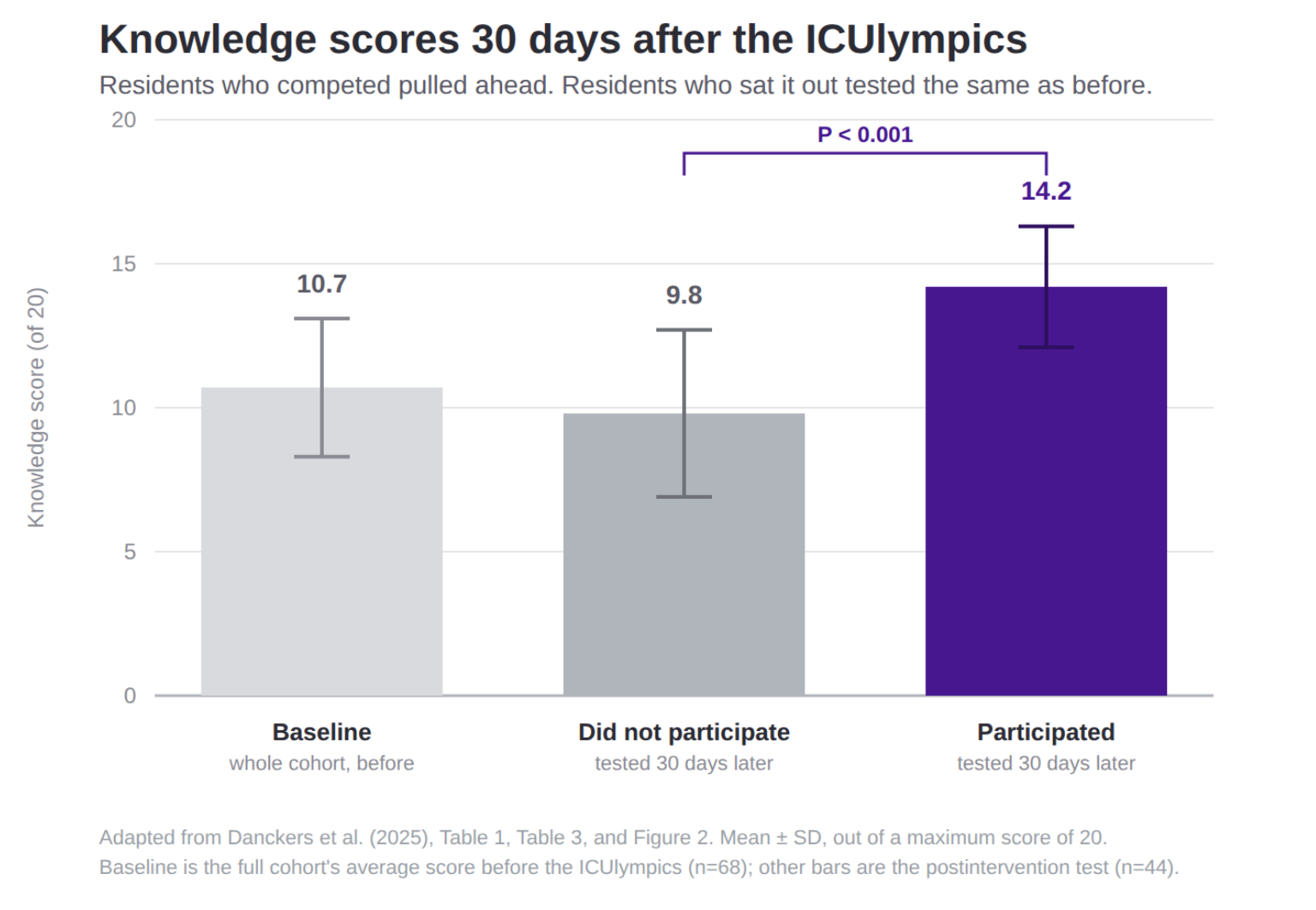
Residents who fully participated in the ICUlympics scored well above their nonparticipating peers on a knowledge assessment 30 days later, while nonparticipants scored about the same as the cohort’s average before the competition began.
Active recall helped build stronger memory retention
The researchers built a question bank based on content from the American Board of Internal Medicine and American Board of Emergency Medicine certification blueprints, and piloted it among pulmonary and critical care fellows and nonparticipating residents before using it to measure results.
The design of the competition wasn’t only to test participants’ knowledge, but also connect the activities to what is known as testing effect. It means that knowledge retention improves when learners retrieve information from memory repeatedly, under a bit of time pressure, rather than simply re-studying the same material.
Participants also came away with more positive views of game-based learning. Compared with nonparticipants, they agreed more strongly that the games were an effective way to learn new knowledge and that games should be scheduled regularly into their training curriculum. The researchers note that the celebratory nature of a competition like this could shape perceptions on its own, separate from the educational content. This is why they conducted the post-game knowledge test about thirty days later.
Participants felt a stronger sense of belonging and less burnout
In the post-survey, participants and non-participants were asked about their perceptions of medical training games. While both felt that educational games are an effective method to learn new knowledge (participants 4.8 out of 5, non-participants 4.1 out of 5), the participants agreed far more strongly that the games solidified their sense of belonging to the program (4.8 versus 3.9 out of 5), improved their overall well-being (4.8 versus 3.8), and helped counteract burnout during training (4.8 versus 3.8).
That lines up with why the ICUlympics existed in the first place: to give residents a shared reason to compete, celebrate one another, and feel part of something bigger than their individual rotations, on top of the knowledge gained itself.
The ICUlympics has expanded into a multicenter study of different type of learners
Since the pilot was published in 2025, lead author Dr. Mauricio Danckers, a Pulmonary and Critical Care Medicine fellowship director, said the ICUlympics has grown well beyond Aventura Hospital. The team has brought the competition to multiple hospitals across South Florida and Miami region and is now completing a manuscript describing that multicenter experience. This next phase goes beyond clinical knowledge alone, asking whether a game-based platform like this works as well across trainees with different learning characteristics.
The concept has also spread on its own. The original publication and the team’s social media posts about it led other institutions to ask them to bring the games to regional and national education meetings, indicating a need in the field for more game-based learning.
Game-based learning is a deliberate teaching strategy
According to Dr. Danckers the project’s biggest lesson was that gamification does not have to trade rigor for engagement.
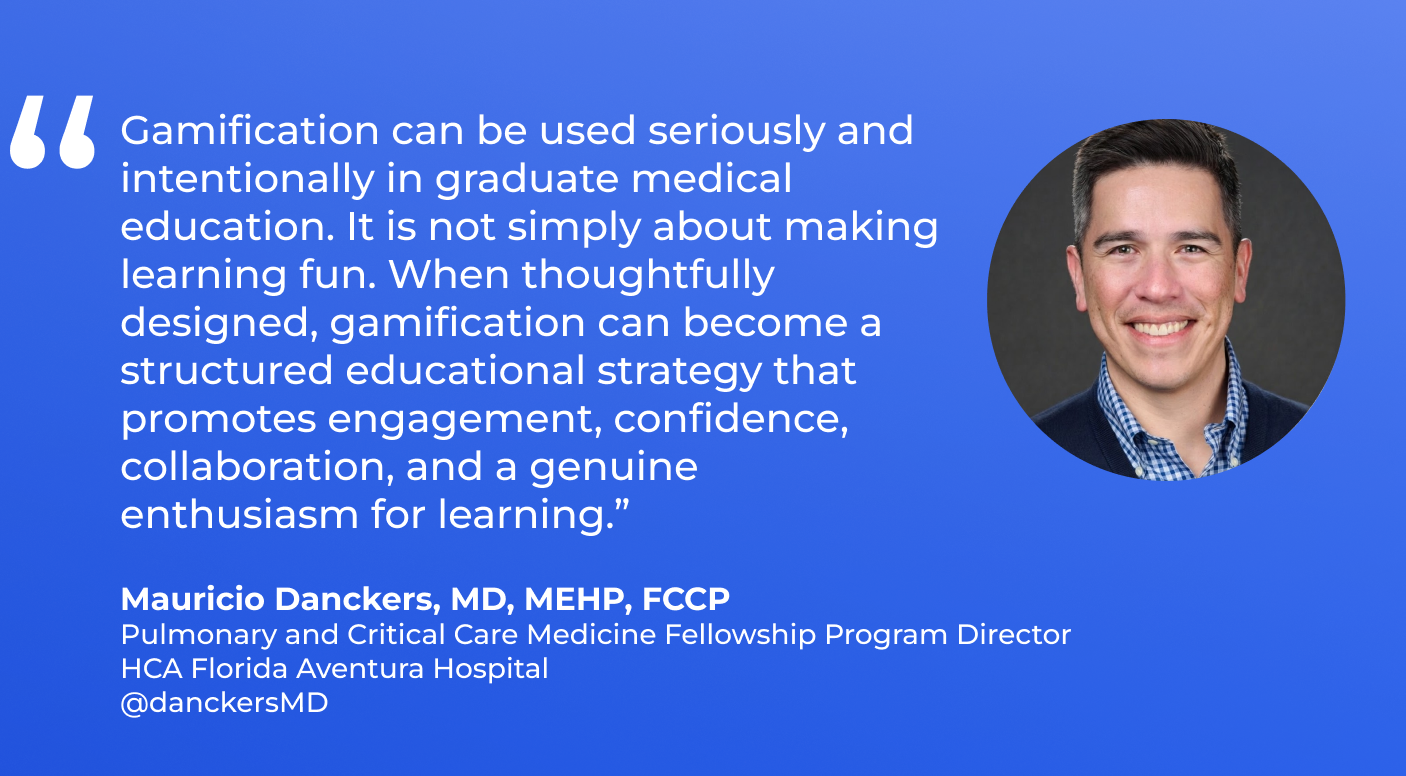
Dr. Danckers continues to use Kahoot! regularly alongside other game-based approaches in his own fellowship program, and values its ability to “transform what might otherwise be a passive educational interaction into something participatory, competitive, social, and memorable, while still maintaining the rigor that we expect in graduate medical education.”
Explore how educators are using Kahoot! to build lasting knowledge across higher education at kahoot.com/research.