
Key takeaways
- Improved learning gains: Students using Kahoot! made roughly twice the progress in English grammar, vocabulary, and science compared with students taught through conventional methods.
- Stronger retention: Two weeks after the lessons, students using Kahoot! still scored higher across all three subjects and retained more of what they had learned.
- Higher engagement: Students using Kahoot! reported feeling more engaged in their lessons than those in the comparison class.
Lessons of course feel successful when students are answering questions correctly. But how much of that learning stays with them after the lesson ends?
That’s what researchers Boulahnane, Ismaili, and Haddi (2026) set out to investigate in a Moroccan middle school. Over three weeks, they compared two ninth-grade classes learning the same English grammar and vocabulary, and science content. One class used Kahoot!, while the other followed conventional teaching methods.
Rather than measuring achievement immediately after instruction only, the researchers also tested students again two weeks later.
The results showed that students using Kahoot! made greater gains across all three subjects and maintained higher scores at the follow-up assessment.
Students using Kahoot! made roughly twice the learning gains
The three-week study involved two ninth-grade classes, each with 30 students aged 14–15. Both classes covered the same English grammar and vocabulary, and Life and Earth Science content over the same amount of instructional time.
One class learned with Kahoot!, while the other followed conventional instruction involving teacher explanations, textbook exercises, and pair-work drills.
During Kahoot! sessions, teachers displayed quiz questions on a shared screen while students responded using phones or tablets. After each question, the class saw the correct answer and how responses were distributed. Teachers briefly reviewed the questions that many students had answered incorrectly before moving on.
Students completed a separate 20-item test for each subject before instruction, which followed immediately after the test , and took the same test again two weeks later.
Both classes started with similar scores, but the differences became clear after the lessons.
From pretest to immediate posttest, the students using Kahoot! showed greater improvements across all three subjects:
- English grammar: The Kahoot! class improved by approximately 4.3 points, compared with 2.1 points in the comparison class.
- English vocabulary: The Kahoot! class improved by 4.4 points, compared with 1.6 points in the comparison class.
- Science: The Kahoot! class improved by 4.9 points, compared with 2.3 points in the comparison class.
Two weeks later, the Kahoot! class maintained higher scores across all three subjects, with an advantage of 3.3 to 3.7 points over the comparison class.
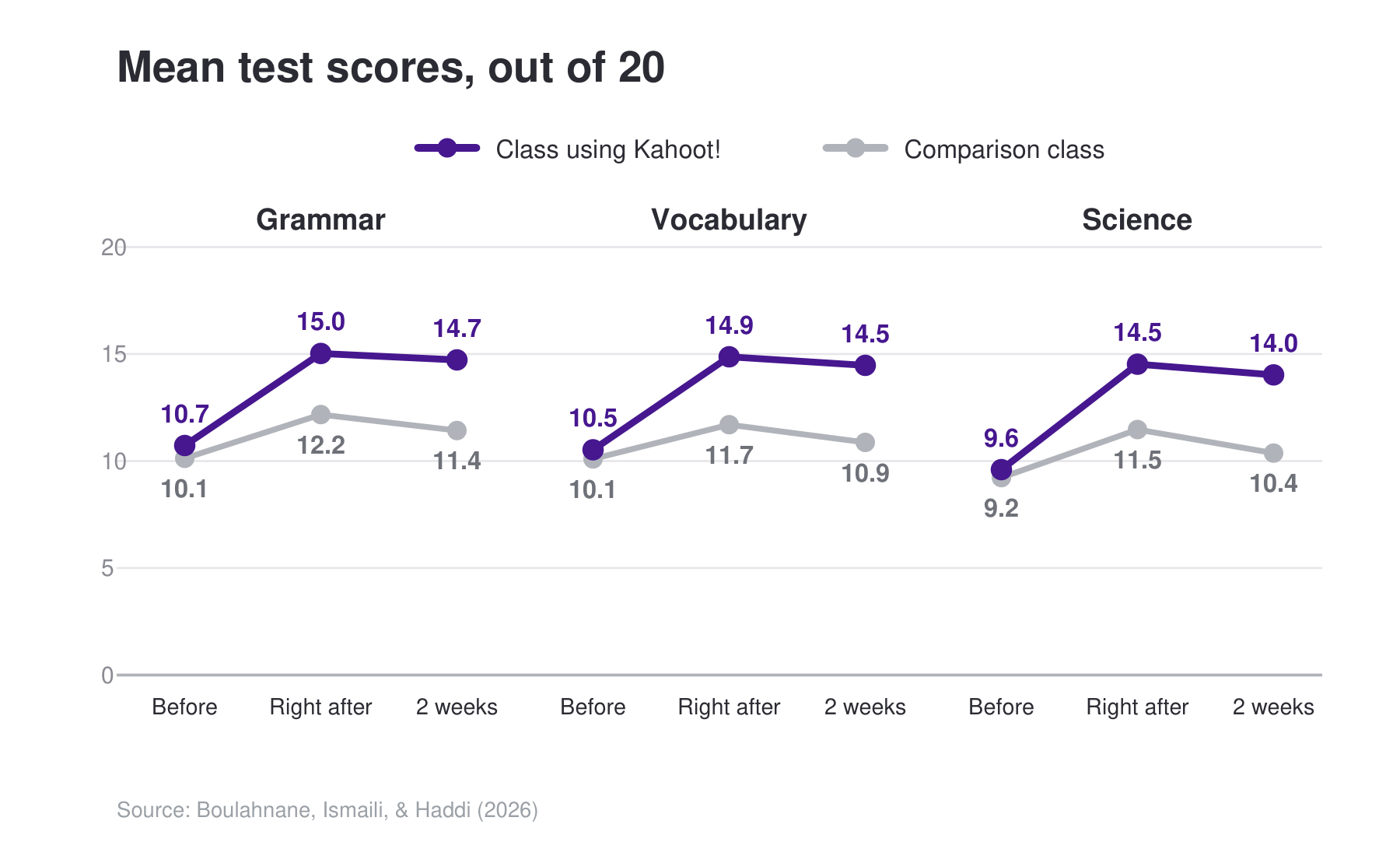
Mean test scores out of 20 before instruction, immediately afterward, and two weeks later. The Kahoot! class maintained higher scores across grammar, vocabulary, and science. Source: Boulahnane, Ismaili, and Haddi (2026).
The researchers suggest that repeated opportunities to recall information, combined with immediate feedback, may have contributed to these results. However, the study did not isolate these elements to determine their individual effects.
The findings also highlight the importance of continued review: although the Kahoot! class retained more of its gains, both groups showed some decline over time.
Students using Kahoot! reported higher engagement
Alongside the learning assessments, researchers asked students about their engagement during lessons.
By completing a survey that measured engagement, students in the Kahoot! class reported an average engagement score of 23.6 out of 25, compared with 17.0 out of 25 in the comparison class.
These results suggest that students experienced the Kahoot! lessons as more engaging than conventional instruction alone.
What can middle school teachers take from these findings?
One practical feature of the Kahoot! lessons was the way teachers used student responses to guide immediate review.
Rather than simply moving to the next question, teachers paused when many students answered incorrectly, explained the correct response, and addressed misunderstandings with the class.
For educators teaching language or science, this offers a simple approach to try: use a kahoot to check understanding, identify questions students struggle with, and discuss the answers together.
While the study involved only two classes at one school and followed retention for just two weeks, its findings add to the growing body of research on Kahoot! and knowledge retention. The findings offer encouraging evidence for game-based learning in middle school and highlight the potential value of combining interactive quizzes with immediate feedback and class discussion.