


Key takeaways
- A classroom micro-experiment is one tiny action, run for a short, fixed window of time, with one signal you agree to watch before you start. Here, the action is letting a small group of students build the weekly review kahoot.
- Students who create the questions understand the material more deeply than those who only answer them.
- You can apply this concept in your own classroom: each week, a different group of students builds a five-minute kahoot on last week’s material, you check it, and the class plays it.
- Use each group’s questions as a window into how deeply they understood the topic. At the end of the experiment, decide whether to keep the routine, adjust it, or try a different experiment.
A classroom micro-experiment is the smallest change you can make that still tells you something real: one tiny action, run for a short, fixed window of time, with one signal you agree to watch. You are not committing to a result. You commit to running the test and reading what happens, then deciding what to do next: keep it, adjust one thing and run it again, or try a different experiment.
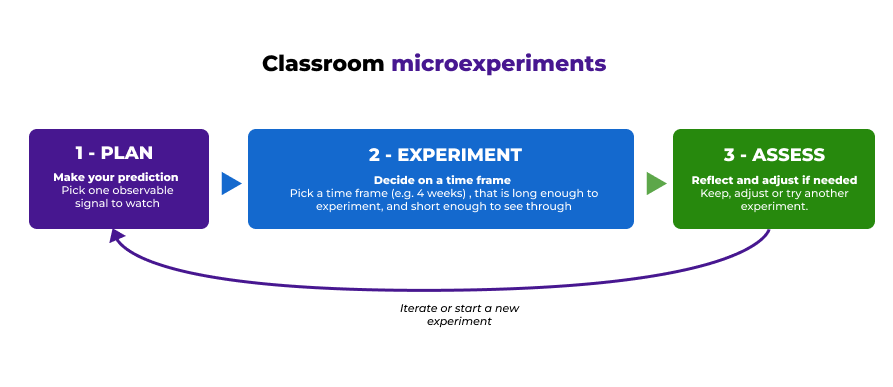
Classroom micro-experiments allow teachers to try out new methods, activities, or tools and get results to guide their next steps.
Creating review questions challenges students to use higher-order thinking
In part 1 of this series, we tested a weekly formative check where the educator writes a short review kahoot and students play it. This time, we hand the creation process over to students.
When you as the teacher create the review kahoot, you do the thinking: deciding what mattered last week, what a good question looks like, and which wrong answers are tempting for a reason. That is higher-order work: analysing, judging, and creating, and it is exactly the kind of active learning you want your students doing. Handing them the pen does not make the review easier; it makes it more challenging, and the effort is where the learning sits.
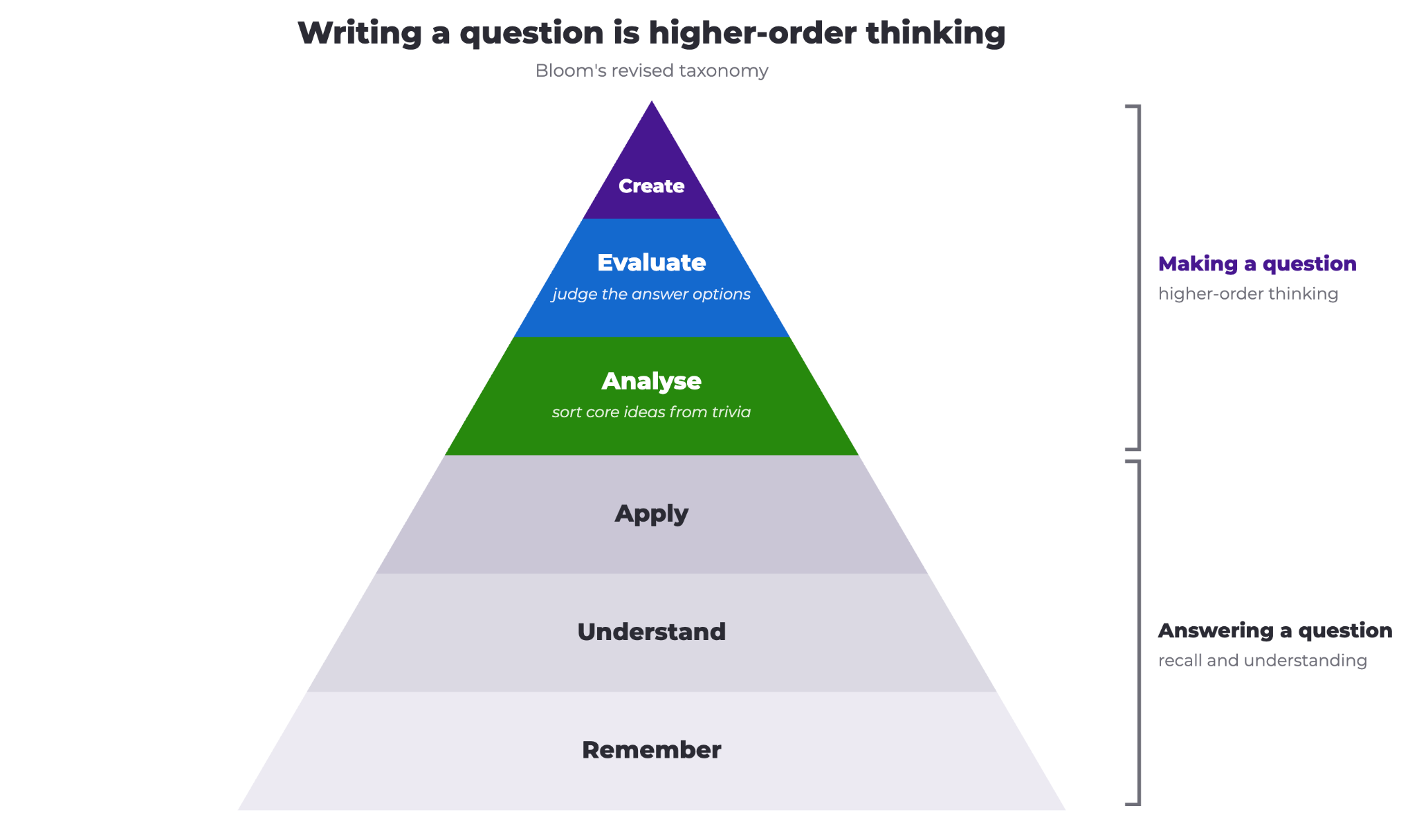
You can see this in Bloom’s taxonomy, a widely used way of ordering thinking skills from simple to complex. At the base sit remembering and understanding facts, the kind of thinking that answering a quiz question usually calls for. Higher up sit analysing, evaluating, and creating, and that is where writing a good question lands. Put simply, formulating the questions asks more of a student than answering them.
The start of a new school year is a good moment to test a small shift in who does that work. You can divide your students into groups and treat it as a rotating activity in one subject. One group, one short kahoot, once a week.
Building a question shows what a student actually understands
One of the best ways to judge whether a student understands a topic is to ask them to teach it. Writing a question for classmates is a small act of teaching, and preparing to teach changes how you study. It gives students ownership of the material and a real reason to ensure they understand the material, not to pass a test but to build a review game for their peers. To write a fair kahoot, they have to revisit the topic, separate the core ideas from the trivia, and decide what is actually worth asking about. That sorting is understanding in action, and for many students it is genuinely rewarding.
There is a double win here. For the group that builds the kahoot, the creating is the review. When the class plays the kahoot, the session serves as a quick formative check that shows you where everyone stands on the material.
The experiment: students build the weekly review
Here is what this micro-experiment looks like in practice:
- The prediction. “If my students write the review questions, they will have to review and understand last week’s material well enough to create a meaningful kahoot, and I will see what they truly grasp and what they do not.”
- The tiny action. Each week, one small group builds the five-minute review kahoot of around 4–10 questions on the previous week’s material. Give them a short guide on what makes a good question (below), and check their kahoot before the class plays it. Rotate the groups so that, over the run, every group gets a turn to create.
- The window. The suggested time window is about 4 weeks up to 2 months, depending on how many groups are creating kahoots. Aim to run at least one kahoot a week for consistency and routine.
- The results. Pick your signal of success before you start, and read it through two separate lenses. Did it help the students learn? Look at how well the creator group grasped the topic, the quality of the questions they wrote, the class’s results, and a short retrieval check. Secondly, does it feel worth it? Ask your students in a low-stakes way whether making or playing the kahoots helped them study. Keep the two lenses separate. Students enjoying the activity is worth something on its own, but it is not the same as learning, and you can be upfront with them about which one you are asking about.
- The decision. At the end of the experiment, you do one of three things: keep it, change one thing about the routine and run the micro-experiment again (pairs instead of groups, or a tighter question template), or drop it and test something else. All three are a win, because now you are making a decision based on the experiment’s observed impact in your classroom.
A short guide for students: what makes a good kahoot question
- Ask about one clear idea, not two at once.
- Make the wrong answers believable. A tempting wrong answer reveals a real misunderstanding.
- Avoid “all of the above” and trick wording. The goal is to check understanding, not to catch people out.
- Write questions you could explain the answer to. If you cannot explain why the answer is right, the question is not ready.
You can give this guide to students as a one-page template, or build it as a short kahoot they play once before their first turn creating.
Maximize learning impact with clear objectives
Plenty of teachers already let students write review questions from time to time, on a good day or when a lesson runs short. The micro-experiment does not add much work; it adds intent. You decide up front what you expect the question-building to do, how long you will give it, and what you will look at to judge it. That small bit of structure is the difference between a nice one-off and something you can learn from. You can compare one week to the next, tell a colleague what you saw, and choose your next move on purpose rather than by feel.
You do not have to completely redesign how you run review this year. Simply give one piece of it, the question-writing, to your students for a short period of time, watch the signal you picked, and let what they produce tell you whether it is worth keeping. It is a small commitment, and a far easier one to keep than a plan for the whole year.
Want to try this one? Set up a group, share the question guide, and let the first group of students build next week’s review. Start a kahoot and see what your students create.
This is part 2 in a Back to School series on classroom micro-experiments. Next: what if the game were played in teams? In part 3, we test whether team play brings your quiet students in.