

For Debbie Bohanan, a Video and Media teacher at Zenith Accelerated Academy in Orlando, Florida, digital assessment has long been part of her teaching process. A long-time Kahoot! user, Debbie regularly incorporates Kahoot! into daily instruction and review, giving students frequent opportunities to practice content, check their understanding, and revisit concepts.
So when her district mandated that all end-of-year assessments be digitized for the 2025–26 school year, the transition was seamless.
Her students were already comfortable with digital assessment. Through Debbie’s decade of using Kahoot! for formative assessment, she’s facilitated over 2,100 kahoot reports. These stats don’t lie – Debbie already had a routine for administering pre-assessments and using the results to inform instruction. And, importantly, she had a way to turn the district’s existing paper-based assessment into an interactive digital review experience without manually rebuilding dozens of questions.
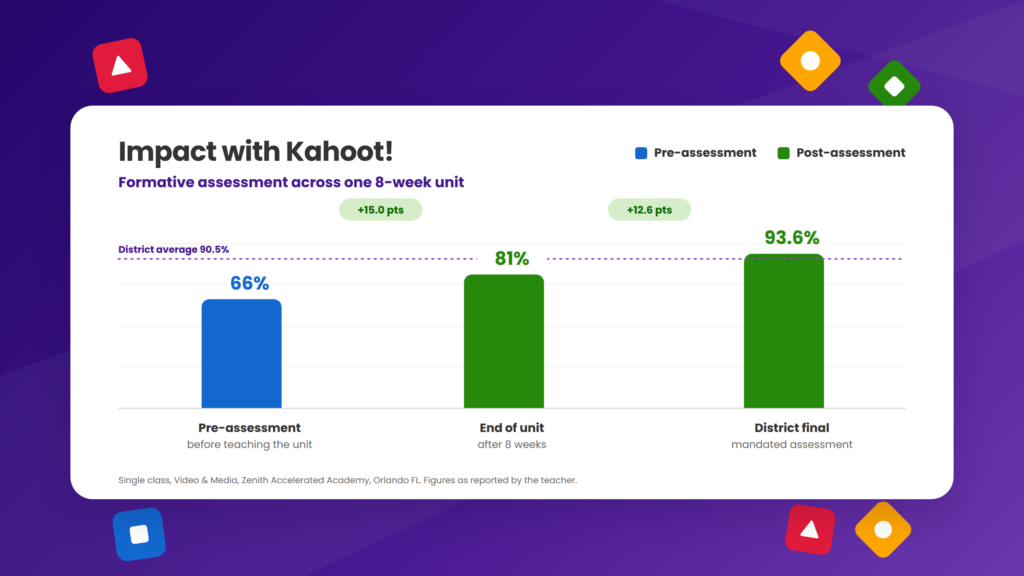
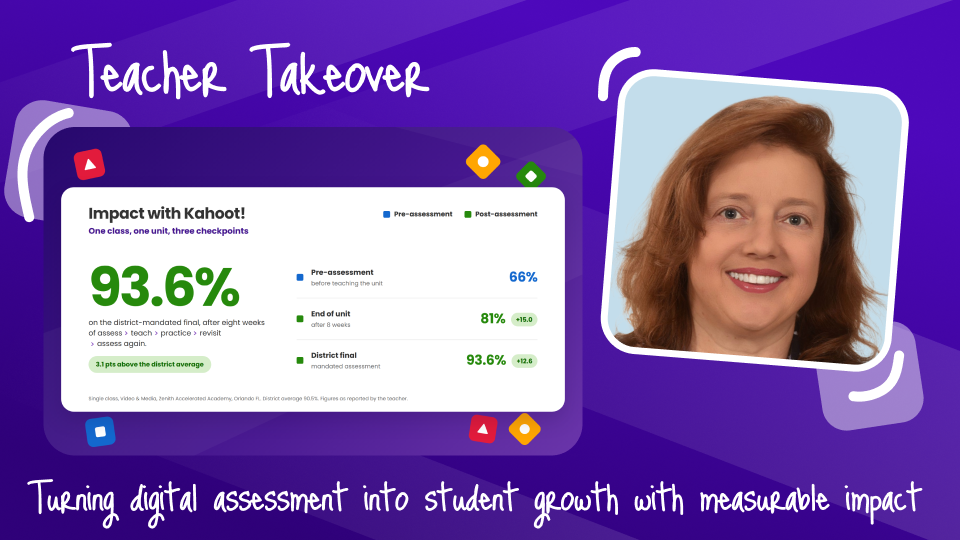
What followed was a measurable progression in student performance: 66% on the pre-assessment, 81% after eight weeks of instruction, and 93.6% on the district-mandated assessment—3.1 percentage points above the district average.
The results at a glance
The progression represents a 15-percentage-point increase from the initial assessment to the end-of-unit assessment. On the final district assessment, Debbie’s students outperformed the district average by 3.1 percentage points.
But the numbers don’t tell the whole story. The real impact came from what happened between those assessments.
Starting with a baseline
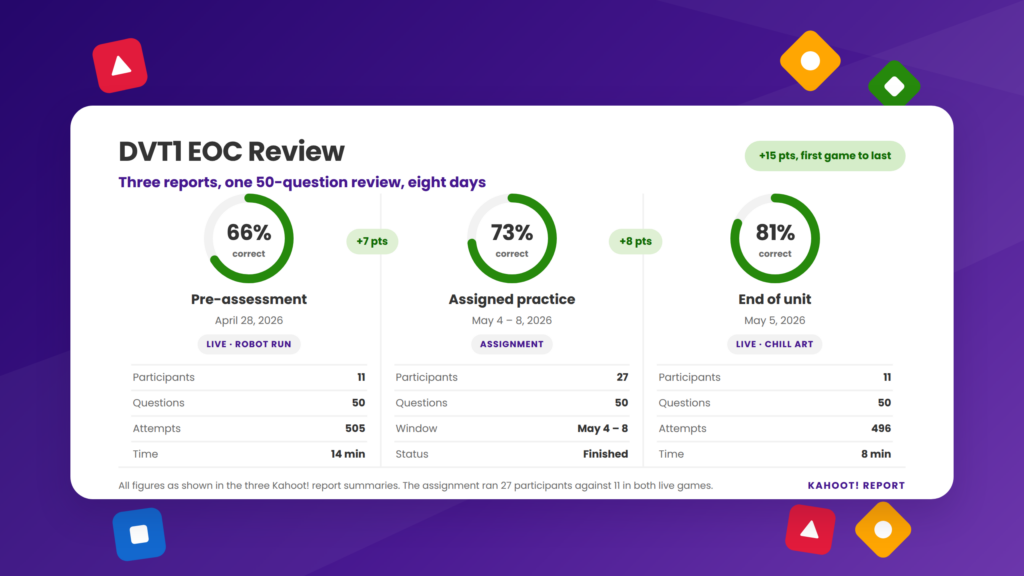
When Debbie administered her pre-assessment, her students averaged 66%. For Debbie, that score wasn’t simply a measurement of what students didn’t know. It was a starting point. Because Kahoot! was already part of her daily classroom routine, students were familiar with the process of answering questions digitally, receiving feedback, and engaging with review activities. There was no significant learning curve around the technology itself. That familiarity gave Debbie the opportunity to focus on the instructional work ahead: identifying areas that needed reinforcement and creating repeated opportunities for students to practice.
Over the next eight weeks, Kahoot! remained part of that process. Students encountered key content repeatedly through classroom instruction, review activities, and assigned game experiences. Rather than relying on a single study session before an assessment, Debbie built repeated exposure into the learning cycle. At the end of the unit, the class average had increased to 81%. That’s a 15-percentage-point gain from the original pre-assessment.
Turning a 50-question paper assessment into interactive practice
There was, however, another challenge to solve. The district’s assessment contained 50 questions, and because it was being used for standardized district reporting, the questions needed to exactly match the language students would encounter on the official assessment. Manually creating a 50-question Kahoot! would have taken Debbie a significant amount of time across many planning periods and after-hours sessions. She would have needed to type every question and answer option while ensuring the wording remained faithful to the original assessment.
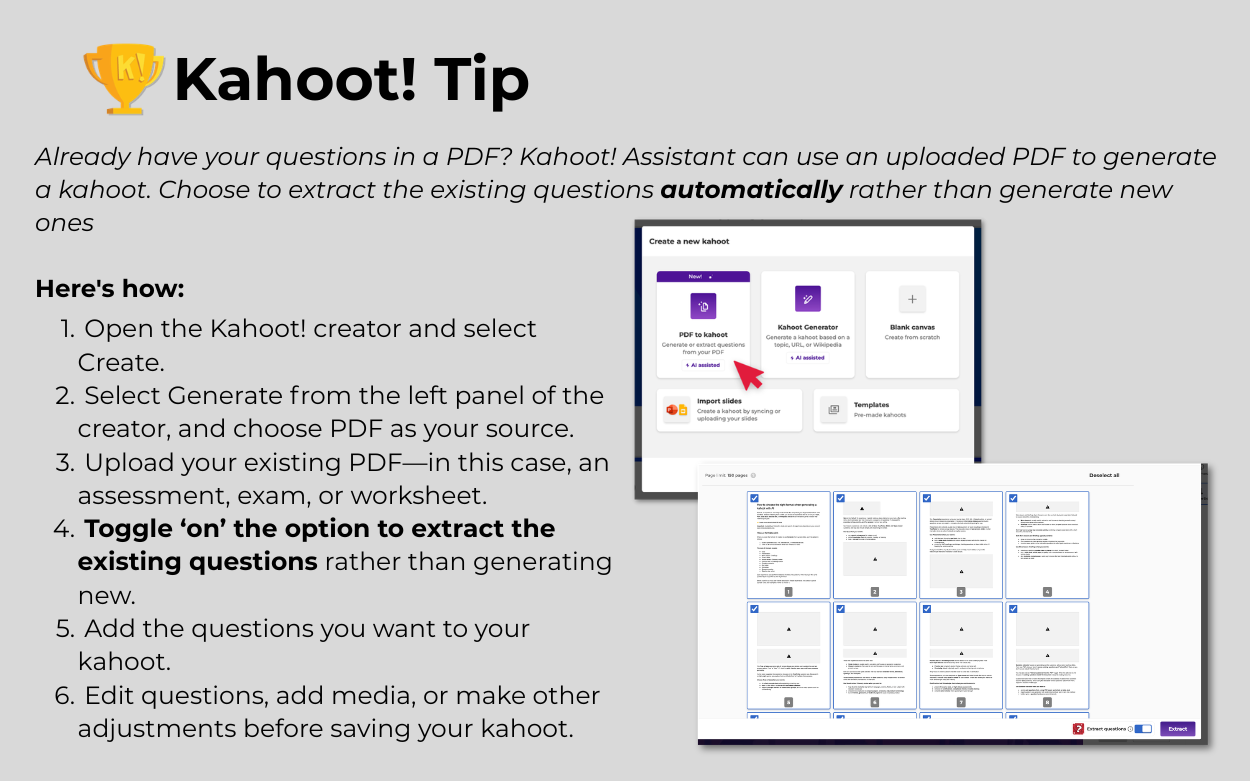
Instead, she used Kahoot!’s PDF question extraction capability. By uploading the existing paper-based assessment as a PDF, Debbie was able to transform the ready-made questions into an interactive Kahoot! in seconds. The questions could then retain the language and content students were expected to know, while gaining the engagement and flexibility of digital practice. For Debbie, this workflow turned what could have been hours of manual preparation into a matter of seconds—and gave students a way to practice the actual questions and language they would encounter on the district assessment.