


app store badge google play badge

Get the mobile app for the best Kahoot! experience!

Hannah Harris 8 Jul 2026

Back to case study

Teacher Takeover: More than a quiz with stronger tech communities

How Kahoot! helped to build stronger tech communities across Uganda.

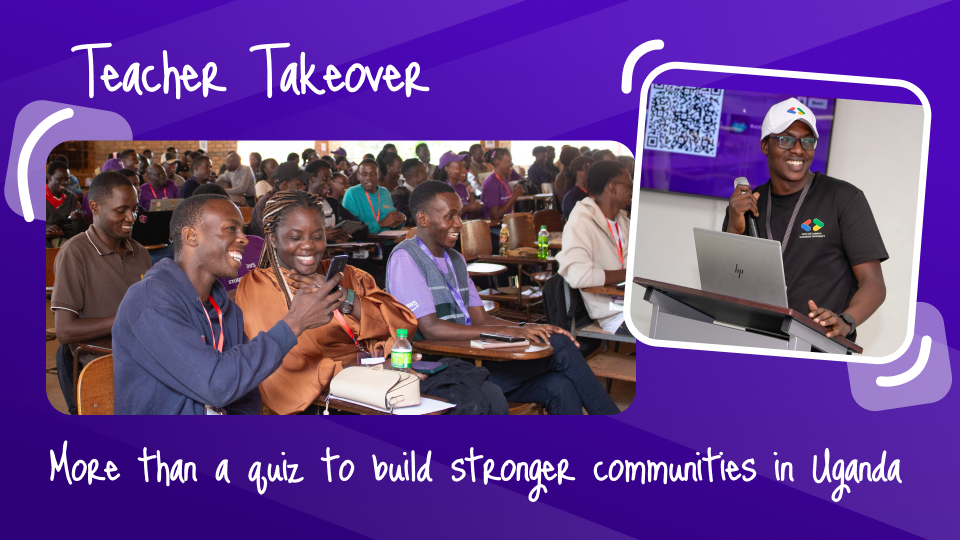
Teacher takeover blog cover, "More than a quiz to build stronger communities in Uganda" text with students smiling playing kahoot on phones

Kahoot! Ambassador, Benjamin Wakida is a Tech Educator, Business Computing student at Makerere University Business School. In addition, he’s busy as an AWS Student Builder Group Leader, UiPath Student Developer Champion Tech Educator and Community Builder. Benjamin organizes and facilitates technology events across Uganda, with a focus on making technical learning interactive, inclusive and community-driven.

Picture a room of more than 50 people who arrived as strangers: developers, students, community builders and curious newcomers seated together for a day of technical learning. For the first hour, the atmosphere is politely attentive. Laptops open. Notebooks out. Eyes forward. But the energy is thin. The speaker is captivating. The content is valuable. And still, more than half the room is quietly somewhere else.

I have stood at the front of that room more times than I can count. And I have watched Kahoot! change the energy and dynamic  in under sixty seconds.

Here is what I have learned after using Kahoot! across dozens of tech events in Uganda: it was never really about the quiz. It was always about what the quiz made possible — the laughter, the debate, the connection, the moment when 50+ strangers stopped being an audience and started being a community.

Over fifty people, one silent room

Across the technology events I have organised and facilitated in Uganda including AWS Student Community Day Uganda, multiple AWS Student Builder Group sessions at Makerere University Business School, the Notion Community Event, blockchain and Web3 meetups and developer workshops. One challenge has remained constant: events regularly draw 50 or more participants, and that scale makes engagement harder, not easier.

At events over 50 attendees, the informal dynamics that keep a small group lively simply break down. Shy participants become invisible. The introverts retreat. The few confident voices dominate. Everyone else becomes an audience, and audiences drift. The irony is that these are motivated people. They showed up voluntarily. They want to learn. But the format is working against them.

At 50 people, engagement is no longer something that happens naturally. It has to be designed.

Benjamin W., Uganda

When the music starts, the room transforms

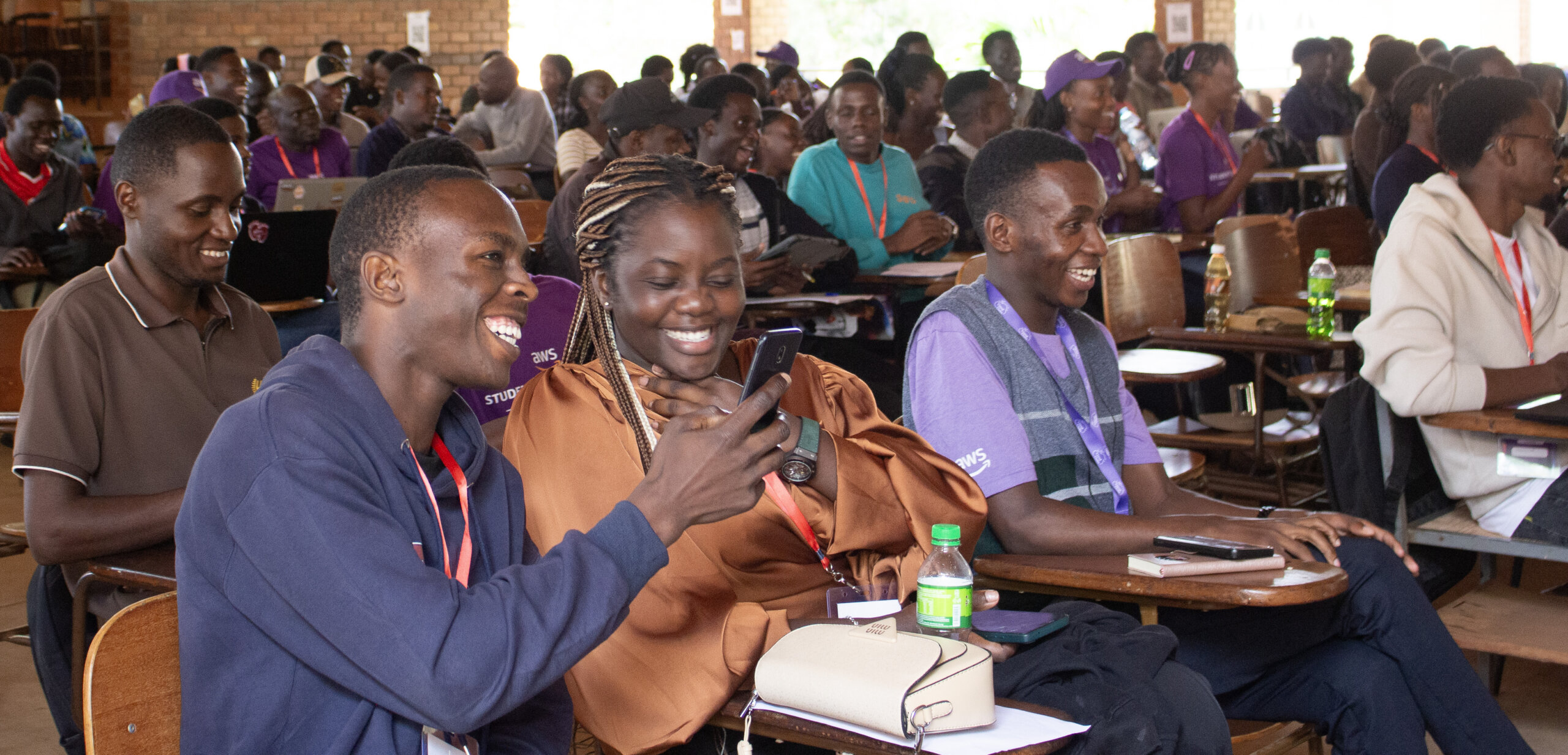
The first time I launched a live kahoot in a room of 40 participants, the shift was immediate and almost physical. Within seconds of the countdown music beginning, bodies that had been slumped forward were upright. Phones raised in both hands. A ripple of laughter moved across a room of strangers who had barely spoken to one another all session.

Over 35 people answered the first question simultaneously. The leaderboard appeared. Someone in the third row pumped their fist. Two participants near the back started a rapid debate about which answer had been correct. A participant who had not said a single word all morning turned to her neighbor and said, laughing: “I cannot believe I got that wrong.”

That moment and collective reaction is what no slide deck can produce, but what Kahoot! consistently delivers. And it is only the beginning of what this energy and enthusiasm can build.

students smiling looking at phone screens playing kahoot

What happened at our events

At AWS Student Community Day Uganda, with more than 150 attendees gathered for a full day of cloud computing sessions, Kahoot! became the connective tissue of the programme. Short quizzes between presentations on AWS services, IAM concepts, and cloud architecture served as both a learning reinforcement and an energy reset. Participants who had been passively absorbing content for 45 minutes were suddenly leaning forward, competing and discovering in real time which concepts had genuinely landed.

At the Notion Community Event, where I facilitated a Kahoot! session for an audience that ranged from first-time users to power users, the quiz did something I had not fully anticipated: it levelled the room. Beginners found they could answer questions confidently. Experienced users were caught out by features they had never explored. The competition was not between skill levels, but between everyone and the material. That equality of engagement in a diverse room of 30-plus people is something I have rarely seen achieved any other way.

Across developer meetups and blockchain community sessions, the pattern repeated. Participants who contributed nothing to open Q&A became some of the most competitive Kahoot! players in the room. The gamified format gave introverts a lane, a way to demonstrate knowledge without the vulnerability of speaking publicly. Several participants told me unprompted, after the session, that the Kahoot! had been their favorite part of the day and just like that we can never fail to have an event without a Kahoot!.

Kahoot! gave the quietest person in the room the loudest voice on the leaderboard.

Benjamin W., Uganda

Beyond the quiz: Where the real building happens

The impact of Kahoot! at scale is not just about learning outcomes, it is about what happens between people. When 100 strangers all groan simultaneously at a tricky question, they stop being strangers. When the leaderboard shuffles in the final round and the crowd reacts together, that shared moment becomes the foundation of conversation at the networking break, at lunch, and in the WhatsApp groups that form after the event.

I have watched participants exchange contacts because of a Kahoot! debate that started mid-session. I have seen community members return to subsequent events largely because of the social energy the Kahoot! session created. For growing tech communities in Uganda, where the ecosystem is still being built and human connection is as important as technical knowledge, that social dimension of gamified learning is not a nice extra. It is foundational.

This is what I mean when I say it goes beyond the quiz. Kahoot! is the spark, not the fire. The fire is the community that forms around the shared experience curious people who might never have spoken finding common ground over a question about cloud regions or a Notion workflow they both got wrong.

The stronger community we kept building

As a Kahoot! Ambassador, I have come to believe that the measure of a great technology event is not how much information was delivered. It is how many people left feeling that they belonged in the room. Kahoot!, at its core, answers that question for everyone in the audience not just the confident, not just the experienced, but all 50-plus people who came because they wanted to grow and needed a format that met them where they were.

Every leaderboard we celebrated, every wrong answer that sparked a hallway conversation, every shy participant who left with three new contacts that is the community we were building all along. The quiz was just through the door.

That inspiration has now grown into something even more intentional: a monthly quizzing initiative we call Akilithon. Through Akilithon, we will continue using the Kahoot! platform to host technology-focused quizzes that help us test, celebrate, and better understand how actively people are engaging with the tech space. It is our way of turning the energy we have seen in individual events into a recurring community experience, one that keeps people learning, competing, connecting and showing up month after month.