


Key takeaways
- A quasi-experimental study (n=61) found the group using Kahoot! outperformed conventional instruction on both an immediate and a delayed post-test.
- Both groups started at near-identical levels (~15 points). After eight weeks, the group using Kahoot! scored 95.6 vs 57.1 for the control group on receptive vocabulary.
- Tested weeks later, the group using Kahoot! held onto its gains, while the control group stayed far behind and slipped slightly.
Engagement is easy to see in a Kahoot! session. Retention takes longer to measure. A new study by Sun & Tan (2026) set out to answer the question: does vocabulary practice with Kahoot! produce retention weeks after the learning session?
The group using Kahoot! retained vocabulary weeks after instruction
Sun and Tan ran a quasi-experimental study with 61 university students, one group using Kahoot! for ESP (English for Specific Purposes) vocabulary practice and one following conventional methods, tested immediately after instruction and again weeks later. The group using Kahoot! outperformed on both. More importantly, their forgetting curve was noticeably flatter, meaning that the learning held.
Vocabulary loss after instruction is a known challenge: students often perform well immediately after a lesson but retain less over time. The delayed post-test was designed to catch exactly that. Vocabulary depth was also measured using the Vocabulary Knowledge Scale (VKS), which goes beyond surface recognition to assess whether students can use and define a word, not just identify one they recently saw.
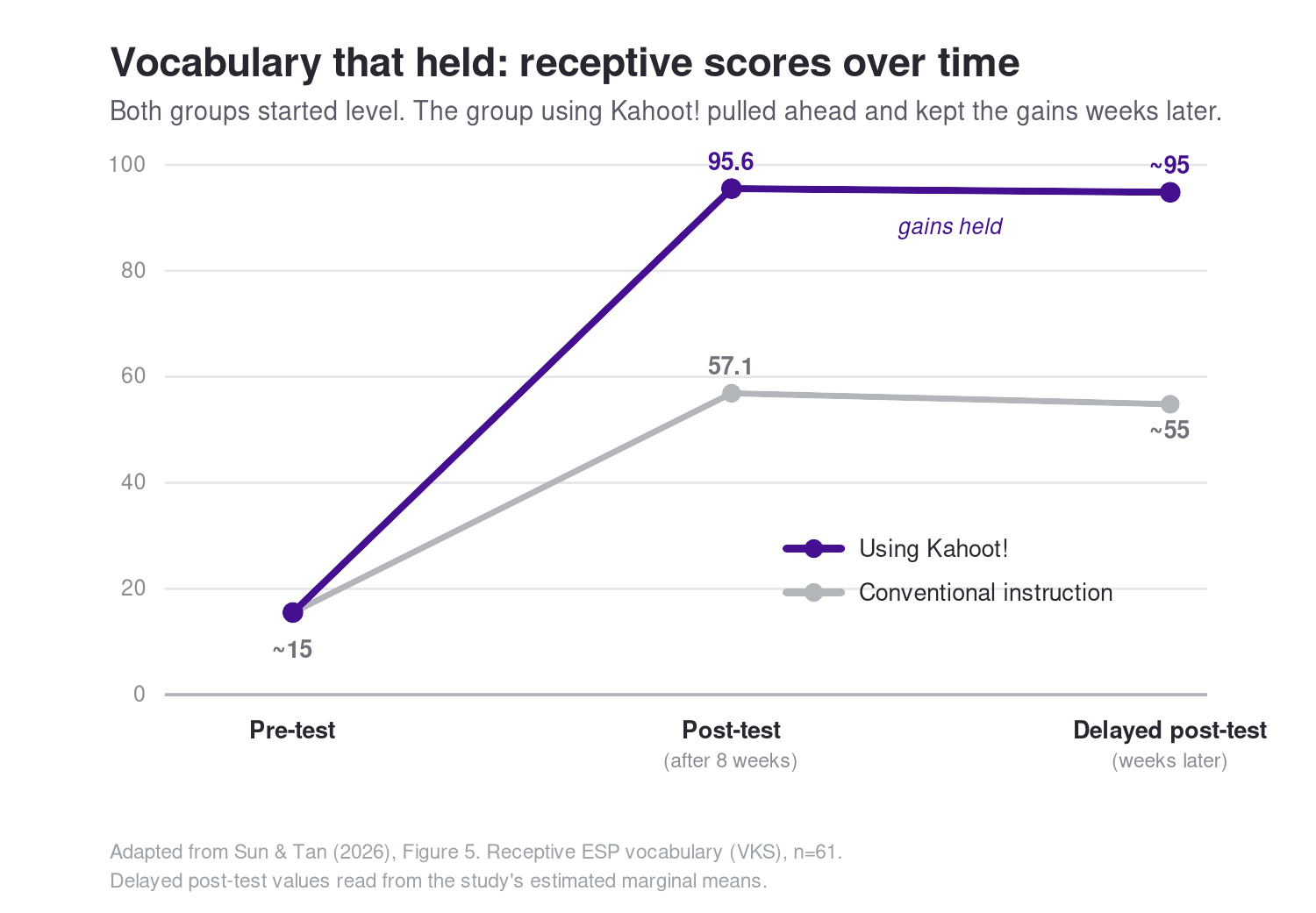
Receptive vocabulary scores across the three test points. The two groups started level; the group using Kahoot! rose higher and held its gains at the delayed test, while the control group settled far below. Adapted from Sun & Tan (2026), Figure 5.
Active retrieval practice made vocabulary stick
The study not only shows that the group using Kahoot! remembered more. It points to why. Every session asked students to pull a word from memory, again and again, under a little time pressure. That act of retrieval, not rereading, is what cognitive science ties to durable memory. The games also used images that students could use to recall the vocabulary: “When I remember the pictures, I can recall the words better,” one wrote. Another named the repetition directly: “Kahoot! helps me review difficult terms repeatedly, which improves my memory.“
Two design choices made that repeated retrieval feel safe enough to attempt. Nicknames let students answer without exposure, so a wrong guess cost nothing in front of peers. “I’m an introvert, unwilling to participate, but Kahoot! lets me try,” one student said. Frequent retrieval, spaced across weeks and kept low-stakes, is a well-established route for moving vocabulary from short-term recognition into memory that lasts. It also fits the delayed-test result: what students retrieve and reconstruct, they tend to keep.
Game-based vocabulary practice produced lasting learning
For educators who have wondered whether Kahoot! drives lasting learning, this research offers a clear answer: used intentionally as a core vocabulary practice method, it can produce learning that lasts. The group using Kahoot! saw their scores move from 15.7 to 95.6 on receptive vocabulary over eight weeks, then retained those gains at the delayed post-test. The control group started at a similar level (15.4) and reached 57.1 after instruction, then drifted down slightly weeks later, staying well below the group using Kahoot!.
For language teachers, the implication is specific: Kahoot! used as a practice method throughout instruction, not just as an occasional warm-up, appears to support the kind of encoding that resists forgetting.
This study adds to an existing evidence base on Kahoot!’s effect on learning outcomes. A 2024 meta-analysis by Özdemir, synthesizing 43 experimental studies, found a very large positive effect on retention specifically, the strongest signal across all variables measured. The evidence has been building for over a decade.
To learn more about Kahoot!’s evidence base, visit our research page.