


app store badge google play badge

Get the mobile app for the best Kahoot! experience!

Hannah Harris 24 Jul 2026

Back to case study

Teacher Takeover: How one STEM teacher uses Kahoot! formative assessment to boost scores by over 30%

Read on to learn how Kahoot! Ambassador and STEM teacher used formative assessment and game-based learning to reinforce engineering vocabulary, monitor growth, and support hands-on learning.

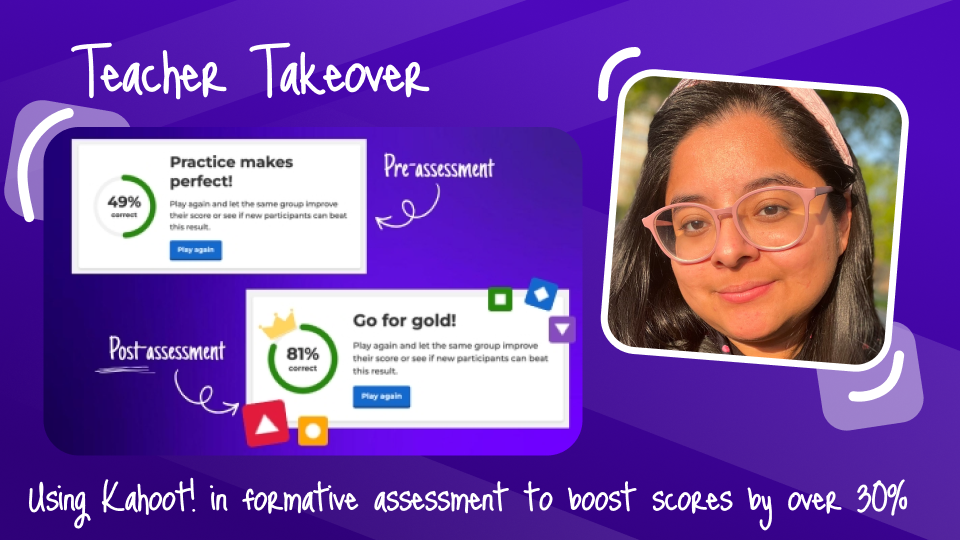
"Teacher Takeover: Using Kahoot! for formative assessment" text with graph of several assessments and scores

When elementary students walk into STEM class, they aren’t just learning how to build, design, or solve problems, they’re learning an entirely new language.

For one elementary STEM educator, the solution wasn’t adding more worksheets or memorization activities. Instead, she embedded formative assessment throughout her units, using Kahoot! to introduce key concepts, revisit over time, and measure growth as students moved from learning vocabulary to applying it in authentic engineering tasks.

Across multiple grade levels and engineering standards, the result was the same: students entered projects with greater confidence, stronger content knowledge, and a shared language for problem-solving. Read on to learn how Kahoot! Ambassador and STEM teacher used formative assessment and game-based learning to reinforce engineering vocabulary, monitor growth, and support hands-on learning.

Starting with vocabulary, not rote memorization

In STEM, vocabulary isn’t an isolated skill, it’s a tool students need to think like engineers.

In Ms. Lainez’s classroom, first graders are introduced to the engineering techniques and design skills they’ll use throughout future STEM lessons at the beginning of a school year. Many students, however, have difficulty remembering the names of these techniques or understanding when to apply them.

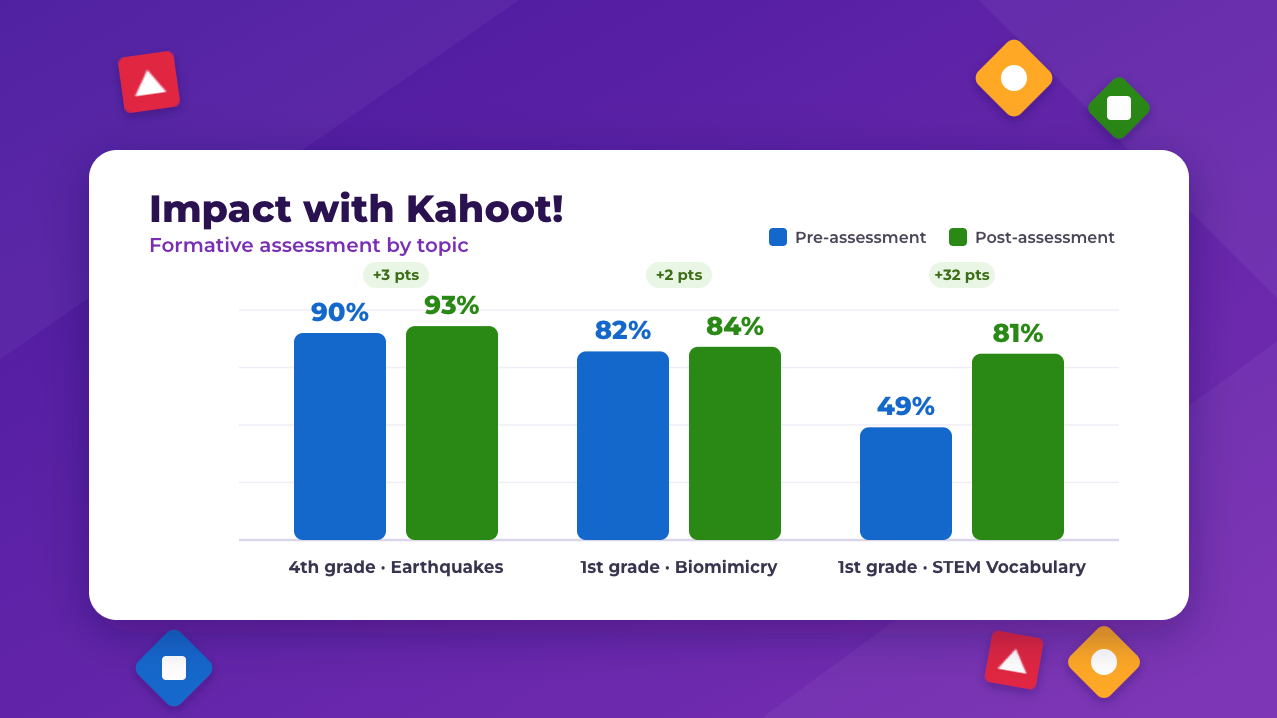
To help combat confusion and overwhelm navigating new vocabulary, Ms. Lainez created a kahoot that served as both a pre-assessment and an engaging introduction to foundational STEM concepts. Students explored vocabulary and engineering techniques they would rely on throughout the year, like materials, mechanisms for construction, and even force and motion theories. The pre-assessment confirmed what Ms. Lainez suspected: many students were still developing their understanding of both STEM vocabulary and foundational engineering practices. The class averaged 49%, providing a clear starting point for instruction.

Over the next three weeks, students participated in explicit teacher modeling, guided practice, STEM centers, student demonstrations, and hands-on engineering challenges. While the content and curriculum paced through an entire unit and changed each day, one key element stayed consistent. Kahoot! was the main instructional tool and delivery format. While students practiced hands-on learning by manipulating cardboard, tearing tape by hand, and constructing movable mechanisms, the content-based curriculum focused consistently on applying the vocabulary introduced during the original kahoot.

When students completed the assessment again, the class average had increased to 81%.

The improvement wasn’t just reflected in the data. Ms. Lainez explained that, “students were more confidently using engineering terminology to explain design decisions, discuss materials, and communicate their thinking throughout the engineering process.” Where did this confidence come from? The repeated exposure, review, and remediation native to the Kahoot! learning experience. Learning and assessment were presented via a Treasure Trove game experience, a flipped-classroom, and student-centered instructional approach within Kahoot!. By launching lessons via Treasure Trove in Kahoot!, Ms. Lainez’s students engaged with the material at their own pace, in a progression and sequence unique to their learning, assessment, and comprehension. And after weeks of review and learning, Kahoot! made all the difference.

[In using Kahoot! consistently] Students were more confidently using engineering terminology to explain design decisions, discuss materials, and communicate their thinking throughout the engineering process.

Elisabeth L., New York

Reinforcing vocabulary through authentic application

The same instructional approach proved valuable with older learners.

During a fourth-grade research unit on earthquakes and natural disasters, students were challenged to create projects that would teach younger elementary students about earthquake safety. They could choose how to demonstrate their learning through a variety of tools, though every project required students to accurately use key earthquake vocabulary.

Before beginning their research, students completed an interactive kahoot, presented by way of a game mode experience, designed to introduce essential academic language. Throughout the unit, that same kahoot was revisited multiple times, providing spaced retrieval practice while allowing the Ms. Lainez to monitor vocabulary retention over time.

Students also encountered this same vocabulary repeatedly as they researched using resources in online texts and digital readers, reinforcing the language in authentic contexts rather than isolated review.

Students entered the unit with a strong understanding, averaging 90% on the initial assessment. By the end of the project, repeated retrieval practice and authentic application had increased the class average to 93%, reaching true levels of mastery by way of Kahoot!.

Unlike a static pre- and post-assessment written assessment, Ms. Lainez can measure exact growth and progress for the students. The learning environment is the same, the material and presentation of concepts is identical; fewer variables means that assessment goals and limitations are visible and easily identified. Although the numerical improvement was modest, students demonstrated greater confidence incorporating precise scientific vocabulary into their presentations and explanations—an important outcome for inquiry-based learning. 

Bar graph comparing pre- and post-assessment scores across three topics of study

Building conceptual understanding before engineering begins

Vocabulary became even more powerful when paired with conceptual learning.

In another first-grade engineering unit, students explored biomimicry—the idea that humans can solve problems by borrowing ideas from nature.

Before students designed their own nature-inspired inventions, they completed a kahoot featuring real-world examples of biomimicry, including the bullet train inspired by the kingfisher, sticky gloves inspired by geckos, and night vision technology modeled after the eyes of cats and owls.

These visual examples gave students a concrete foundation for what can otherwise be an abstract engineering concept.

Previously, Ms. Lainez had introduced biomimicry through a classroom scavenger hunt in which students matched animals with inventions. While students enjoyed the activity, many struggled to explain why each invention had been inspired by nature, and the movement required for the activity reduced valuable instructional time.

Replacing the scavenger hunt with an interactive kahoot created opportunities to present clear visual examples, facilitate rich classroom discussion, and quickly check for understanding before students began designing.

Following a whole-class brainstorming session, students completed another interactive kahoot to determine whether they could correctly identify examples of biomimicry and explain the connection between nature and engineering design.

Students demonstrated a strong understanding from the beginning, averaging 82% on the first assessment and 84% on the follow-up. While the numerical growth was small, Ms. Lainez reports an observed and noticeable difference in classroom conversations and engineering design work. Students entered their projects with a stronger conceptual understanding and were better able to explain how adaptations found in nature could inspire human innovation.

Replacing the scavenger hunt with an interactive kahoot created opportunities to present clear visual examples, facilitate rich classroom discussion, and quickly check for understanding before students began designing.

Elisabeth L., New York

Formative assessment as part of the learning process

Although each classroom focused on different standards and content, from engineering design to Earth science to biomimicry, the instructional pattern remained remarkably consistent.

Students first encountered new vocabulary in an engaging, low-pressure environment with an introductory, pre-assessment kahoot. All the while, Ms. Lainez gathered evidence of understanding before instruction began. Throughout each unit, concepts were revisited through discussion, investigation, research, and hands-on engineering experiences and measured by way of Kahoot!. Finally, students demonstrated not only that they recognized the vocabulary, but that they could apply it while solving authentic problems, reflected in again – that same introductory kahoot.

The assessment data informed instructional decisions every step of the way, helping to identify misconceptions, reinforce challenging concepts, and provide additional opportunities for practice where needed.

Most importantly, formative assessment became more than a checkpoint at the end of learning. It became an integral part of the learning process itself.

For Ms. Lainez and her STEM students, success wasn’t measured solely by improved assessment scores. When students have both the language and the confidence to communicate their ideas, they’re better equipped to think, design, and problem-solve like young engineers.