


app store badge google play badge

Get the mobile app for the best Kahoot! experience!

10 Apr 2026

Back to case study

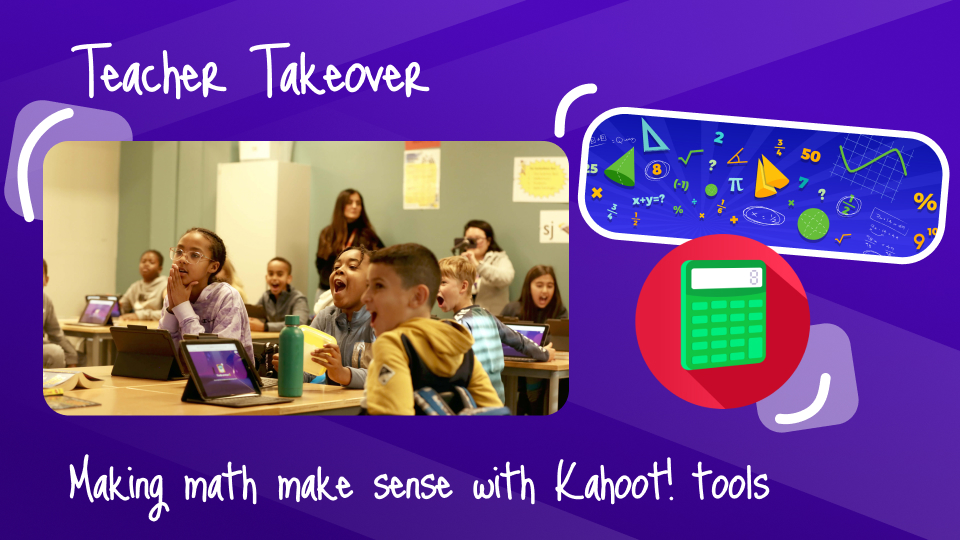
Teacher Takeover: Making math make sense

How Kahoot! supports deeper learning in math through play, practice, and precision.

"Teacher takeover: Make math make sense with Kahoot tools" title

Math lessons and instructional periods are often a balancing act. As educators, we’re constantly navigating the tension between speed and understanding, engagement and rigor, whole-class pacing, and individual needs. How do we give students enough practice to build confidence without losing their interest along the way? For many educators, Kahoot! has become a go-to tool not just for making learning fun, but for making it stick. 

In this Teacher Takeover blog, we spoke with Ambassadors to learn how Kahoot! tools support math instruction, specifically. When all other content and curriculum may allow for ‘gray area’ of discussion, rationale, and reasoning—math learning is based on accuracy. Read on to hear their insights and ideas, and get inspired to bring Kahoot! to your own math lesson.

Move beyond guessing: Building real understanding with active recall

At its best, Kahoot! doesn’t replace traditional instruction, but enhances it. By combining active recall, immediate feedback, and flexible gameplay modes, it creates opportunities for students to engage deeply with mathematical concepts in ways that feel both energizing and meaningful.

“I use Kahoot! every day during my online group tutoring sessions to reinforce core Math and Science concepts in a fun, engaging way. Whether I’m helping Primary 6 students revise for PSLE or Secondary 2 students prepare for weighted assessments, Kahoot! has been an essential part of making learning feel like play. My students often tell me it’s their favorite part of the class—it gets them thinking fast and reflecting on what they’ve just learned” (Razzaq R., Singapore).

One common concern with quiz-based learning is whether students are truly understanding content—or simply guessing. That’s where features like Type answer questions make a powerful difference. Instead of selecting from multiple-choice options, students must generate their own answers. This simple shift moves learners from recognition and recall to reasoning—a critical step in building long-term understanding in math.

Rather than thinking, “I think the answer might be this one…”, students are challenged to say, “I know this is the answer.” This approach is especially valuable when reinforcing foundational skills like:

By requiring students to produce answers independently, teachers can more accurately gauge understanding, and students build confidence in what they truly know.

I use Kahoot! every day during my online group tutoring sessions to reinforce core Math and Science concepts in a fun, engaging way.

Razzaq R., Singapore

Slow down to think deeply

While Kahoot! is often associated with fast-paced gameplay, not every math moment should be about speed. In fact, some of the most meaningful learning happens when students are given time to pause, process, and reason. That’s where game mode experiences, like Chill Art, offer a refreshing shift.

By removing the pressure of speed, this mode encourages students to focus on accuracy over urgency. It creates space for deeper thinking—especially when working through:

  • multi-step problems
  • word problems
  • conceptual questions

This balance between fast-paced recall and slower, reflective thinking helps teachers meet students where they are, and supports a wider range of learning styles.

Instantly turn mistakes into learning opportunities

One of the biggest advantages of using Kahoot! in math instruction is the ability to address misconceptions in real time. Courtney M. in New Zealand shares, “I use [Kahoot!] to spot misconceptions early, so I can address them immediately during class.”

With immediate feedback built into every game mode, students don’t have to wait until homework is graded or a test is returned to find out they’ve misunderstood a concept. Instead, they can see the correct answer right away—while the thinking is still fresh. For teachers, this opens the door to powerful in-the-moment instruction.

  • pausing after a question to unpack common errors
  • discussing why certain answers are incorrect
  • reinforcing key concepts before moving on

This immediate feedback loop helps prevent misconceptions from taking root and turns every question into a teaching moment.

I use [Kahoot!] to spot misconceptions early, so I can address them immediately during class.

Courtney M., New Zealand

Support early learners through visual thinking

In primary classrooms, where students are still developing number sense and confidence, accessibility is key. Using images as answer options can make a significant difference, especially when working on skills like number recognition, counting and “how many” questions, and visual problem-solving.

By reducing reliance on text and abstract symbols, image-based questions allow younger learners to engage more intuitively with math concepts. It also opens the door for more students to participate actively, regardless of reading level or confidence.

Build confidence through collaboration

Kahoot! isn’t just about individual performance, it can also be a powerful tool for building classroom community.

“Today I used Kahoot! for my maths lesson, and the students loved it! It was the perfect way to recap our term of learning. I paired students up—one who had been at school since Term 1 with someone new in Term 4—to build relationships and support confidence across the group.”

Pairing students strategically creates opportunities for peer learning, where more confident students can support those who are still developing their understanding. These moments of collaboration often lead to deeper learning, as students explain their thinking and work through problems together. When combined with lower-pressure game mode experiences like Submarine Squad, this approach can also help reduce math anxiety—making the classroom feel more inclusive and supportive.

Teach smarter with a growing resource library

Beyond student engagement, Kahoot! also supports teachers in working more efficiently.

“One of my favorite features is the ability to retrieve and reuse questions from my own question bank when creating new quizzes. This saves me a lot of time… It’s like having a living resource library that grows with my teaching.” (Razzaq R.)

By building and reusing question banks, educators can:

  • Create targeted reviews across different topics and levels.
  • Adapt existing questions for new groups of students.
  • Develop a long-term bank of aligned, high-quality resources.

This not only saves time, but also allows for more intentional, data-informed instruction over time. When used thoughtfully, Kahoot! becomes more than just a review tool—it becomes a flexible part of the instructional process. Whether you’re introducing a new concept, reviewing for an assessment, or simply checking for understanding, small shifts can have a big impact.

Because in math, it’s not just about getting the right answer—it’s about understanding why it’s right.