Misconception one: a number is a count, not a quantity
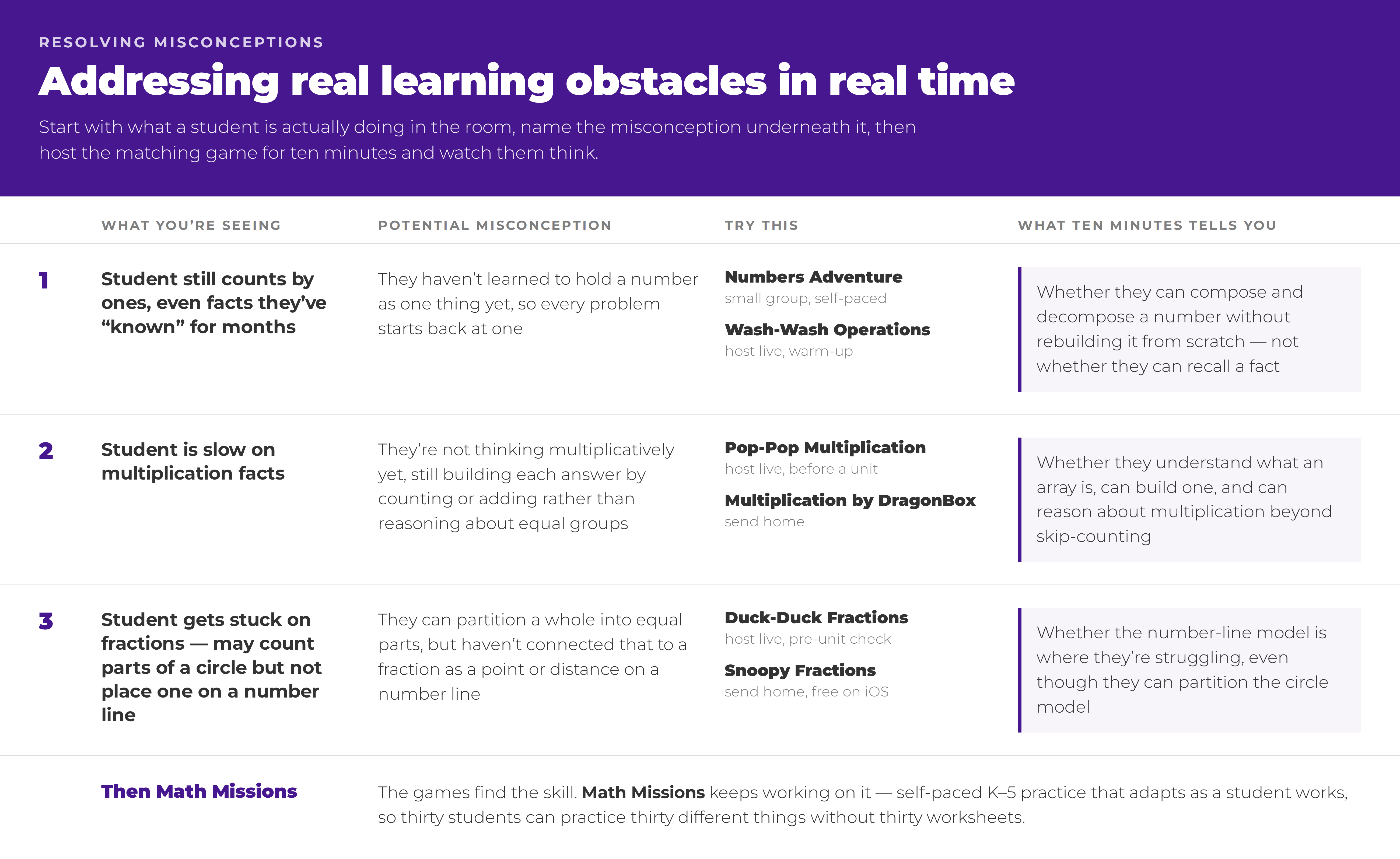
When a student cannot hold quantity in their head, everything downstream costs more: more time, more effort, less confidence. A fourth grader still counting on fingers has an unfinished foundation, and it is probably already showing up in how they handle multiplication and fractions.
Solving with Math Games:
Start a small group on Numbers Adventure, a progression of short sessions on counting and comparing quantities. Because it moves in worlds and levels, students who need the early worlds can stay there without the room noticing. For a whole-class version, host Wash-Wash Operations live — students join at kahoot.it with a pin, the same as any kahoot — as a five-minute warm-up on all four operations.
Why this works
Both Numbers Adventure and Wash-Wash Operations prompt students to manipulate quantity rather than recall a fact, which is what number sense actually is — and Numbers Adventure being solo means a foundation gets rebuilt without an audience.
Misconception two: multiplying without thinking in groups
When a student cannot picture multiplication as equal groups, every fact becomes something to memorize instead of something they can reason out. Slow recall is first a multiplication problem, and it keeps resurfacing after that: as a fractions problem as well as an algebra problem.
Solving with Math Games:
Host Pop-Pop Multiplications live for ten minutes before a division unit. Students drag characters into the play area to build arrays, so they see multiplication as structure rather than reciting a table. Then assign Kahoot! Multiplication by DragonBox for at-home practice on the tables.
Why this works:
The array model separates the student who has not memorized from the student who does not understand what multiplication is. Those two need different interventions, and a timed drill cannot tell them apart.
Misconception three: splitting a shape is not the same as placing a point
Most students can cut a circle into equal parts well before they can place that same fraction as a point on a number line. That is usually where the trouble starts.
Solving with Math Games:
Host Duck-Duck Fractions live as a pre-unit check. You pick a playlist and a duration up to ten minutes, students join with the pin, and the tutorial can stay on for a first run. Watch who hesitates on number lines versus circles — those are different misconceptions. Then send Snoopy Fractions home for students who need longer on the same idea; every world is free on iOS.
Why this works:
Both put fractions on a number line and in circles, which is the representational flexibility standards ask for. And the live version tells you where the class is before you plan the unit, not after the test.
Where Math Missions fits
All Kahoot! math games target specific skills. Math Missions keeps working on these skills: self-paced K-5 practice that adapts as a student works. Include a fifteen minute session in Math Missions to wrap-up a math lesson and it meets every student where they are, without you building fifteen worksheets. Include Math Missions as a rotating center, or even self-assigned review work throughout independent practice – this independent time with students builds autonomy with purposeful, intentional, and targeted instruction.
Math Missions serves as a diagnostic tool, too. “It can be useful for identifying which concepts students have understood and which areas may need further explanation or practice,” says Ika M., a Kahoot! Ambassador in Indonesia, who uses it for review after a concept has been taught. She adds that it “makes mathematics practice feel more like an active learning experience rather than a traditional worksheet or quiz,” and that it “can be integrated into a lesson without requiring a lot of additional preparation” — which is what decides whether a good idea survives a full teaching week.