


Key takeaways
- Early science engagement matters. Disengagement often begins when learning shifts from hands-on exploration to abstract concepts.
- Game-based learning works in elementary grades. Research shows students as young as third grade achieve higher learning outcomes in science using tools like Kahoot!.
- Motivation and focus improve learning. Students learning with Kahoot! show higher confidence, interest, and sustained concentration during lessons.
- The biggest gains are in reasoning. Interactive learning supports deeper understanding, not just memorization.
- Use it strategically. Regular, structured use for review and consolidation delivers the strongest results.
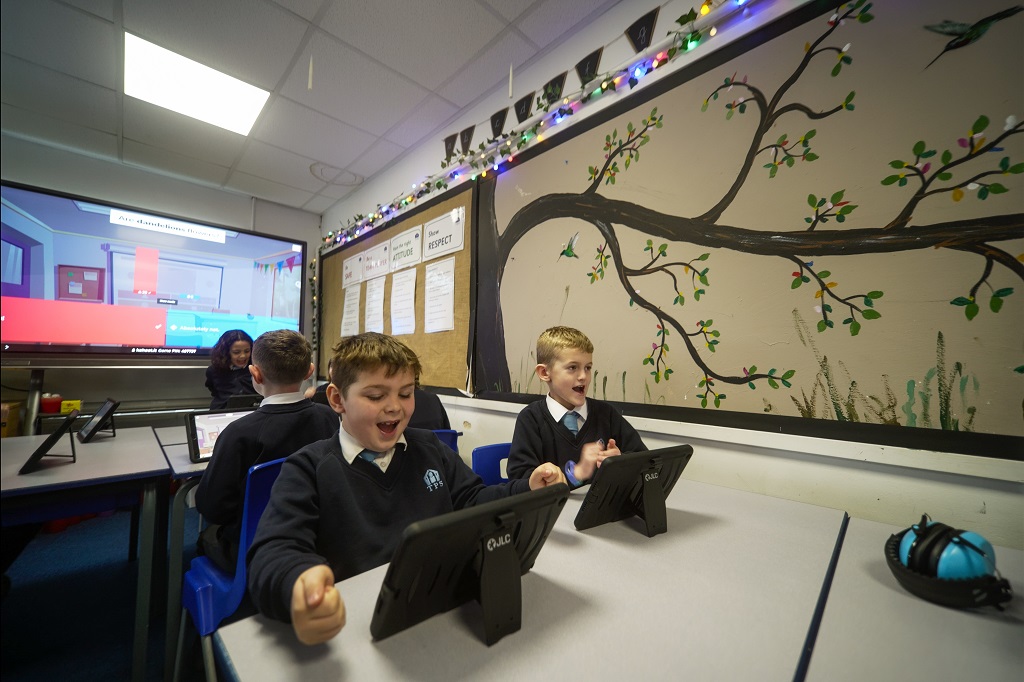
There’s a moment in every child’s science education when something changes.
In the early years of school, science is wonderfully hands-on: planting seeds, watching tadpoles transform, mixing colors, feeling magnets push and pull. Children are natural scientists, endlessly curious, eager to touch, observe, and ask, “Why?”
Then, gradually, science becomes more abstract.
The magnet isn’t magical anymore; it’s electromagnetic fields and polarity. The seed isn’t just growing; it’s photosynthesis, cellular respiration, and nutrient cycles. The exploratory wonder of experiencing natural phenomena gives way to terminology, formulas, and concepts that can’t be seen or touched.
This transition matters enormously. Understanding the world, and eventually succeeding in STEM fields, requires the ability to move from concrete experience to abstract reasoning. Students need to connect what they can see and touch to concepts they can only imagine. For many learners, this is where engagement begins to slip.
The challenge for educators is not whether abstraction belongs in science education (it does), but how to introduce it without losing the curiosity that drew students to science in the first place.
A growing body of research suggests game-based learning may be part of that bridge. And the evidence is stronger than many expected.
What the research shows
Teaching abstract scientific concepts to young learners in a way that actually sticks is one of education’s persistent challenges.
Traditional approaches often assume that young learners need simplified content delivered through conventional instruction.
Recent studies suggest we may be underestimating what’s possible.
In related studies published in the Journal of Baltic Science Education (2022) and in the Journal of Computers in Education (2024), the lead researcher examined the impact of integrating Kahoot! into elementary science classrooms. Using controlled experimental designs, researchers compared students who learned with regular Kahoot!-based activities to peers taught through textbook-based methods alone.
The results were striking: students as young as third grade who used Kahoot! achieved significantly higher post-test scores than other test groups. The effect sizes were large enough to be educationally meaningful, not just statistically significant. These findings challenge the assumption that game-based learning is not “serious learning.”
Motivation matters
Another study (2024) focused on the science education of 5th and 6th graders, published in the journal of Educational Sciences, found that using Kahoot! during science lessons substantially increased the self-efficacy and levels of interest and enjoyment in science, compared to a control group using traditional methods.
The research also found a correlation between students’ motivation and understanding of scientific concepts and principles, indicating that motivated students generally achieve better outcomes. In other words, the “fun” isn’t incidental. It plays a measurable role in the learning outcomes.
More students stay focused with Kahoot!
Another important finding involves student concentration, a common challenge in any classroom, particularly with young learners.
The research found that Kahoot! maintained student concentration at an average of 83% during lessons, while a competing digital solution maintained focus at an average of 64%. It’s not just about keeping students busy. It’s about keeping them cognitively engaged with the material.
Science education often requires sustained attention to follow complex explanations and make connections between concepts. If interactive tools can help maintain attention during these moments, their impact extends well beyond a single lesson.
Strengthening reasoning skills
Understanding science isn’t just about remembering facts. It requires the ability to reason with information and apply it to new situations.
Studies examining Kahoot! in elementary classrooms assessed three cognitive levels: knowing (recalling facts), reasoning (using learned content to solve similar problems), and applying (transferring knowledge to real-life situations).
When looking at conceptual understanding or reasoning, the Kahoot! group demonstrated stronger gains than the control group using another digital platform. This is significant because reasoning, not memorizing, is the foundation of scientific understanding.
Game-based learning boosts knowledge retention
Learning also has a time dimension. Short-term gains that fade quickly do little to support long-term understanding.
These studies also found that game-based learning supported knowledge retention, with students maintaining their understanding of scientific concepts during a follow-up test conducted after two months. Interactive approaches appeared to help move newly acquired information into long-term memory rather than having it fade after the immediate lesson.
Tips for gamifying the science classroom:
Taken together, the research suggest several practical implications:
- Introduce game-based learning early. Students as young as third grade can benefit meaningfully from game-based learning in science.
- Use it strategically. The strongest effects appear when Kahoot! is used to review and consolidate learning.
- Be consistent. Regular integration, at least once a week, produces stronger outcomes than when it is used as an occasional novelty.
- Watch for reasoning gains. The particular strength in reasoning-level outcomes suggests these tools are especially valuable when you’re helping students move beyond memorization to deeper understanding.
Empowering students to reach their science learning potential
None of this suggests that technology is a silver bullet for science education. Thoughtful instruction and rigorous content remain essential.
What the evidence does suggest is that how we engage students, especially in the earliest years, deserves as much attention as what we teach them. When elementary classrooms are structured to sustain attention, build confidence, and support reasoning, young students demonstrate a greater capacity for scientific thinking than we often assume.
The earliest years of science education shape everything that follows. If we allow disengagement to take root early, it tends to compound. But when nine-year-olds show stronger reasoning and retention because their learning environments keep them focused and motivated, we should pay attention.
The research is clear: elementary students are capable of more than we often give them credit for. The question is whether we are willing to design learning environments that rise to meet that potential.